

Executive Summary
Optevo had built a modern, well-regarded platform for project planning, task tracking, and document collaboration. Their users were engaged. Their customer base was growing. And the feedback coming back was consistent: the knowledge was there, but getting to it was still too much work. Searching, summarizing, re-explaining context — tasks that should take seconds were taking minutes, and minutes were adding up.
Optevo’s founders had a clear destination in mind: an AI-first platform where every user has an intelligent co-pilot that understands their work, surfaces what’s relevant, and helps them move faster without leaving the app. Getting there meant more than adding an AI feature. It meant a structural transformation — a new retrieval layer, personalized knowledge indexing, an embedded generative AI assistant, and an agentic automation capability that could take safe, auditable actions on a user’s behalf.
Aegasis Labs designed the AI strategy and delivered all three phases of that transformation. The result is a platform where independent AI features serve users immediately, a knowledge layer understands the team’s work deeply, and an agentic assistant can take real actions — turning Optevo from a place to store work into a platform that actively helps teams get it done.
About Optevo
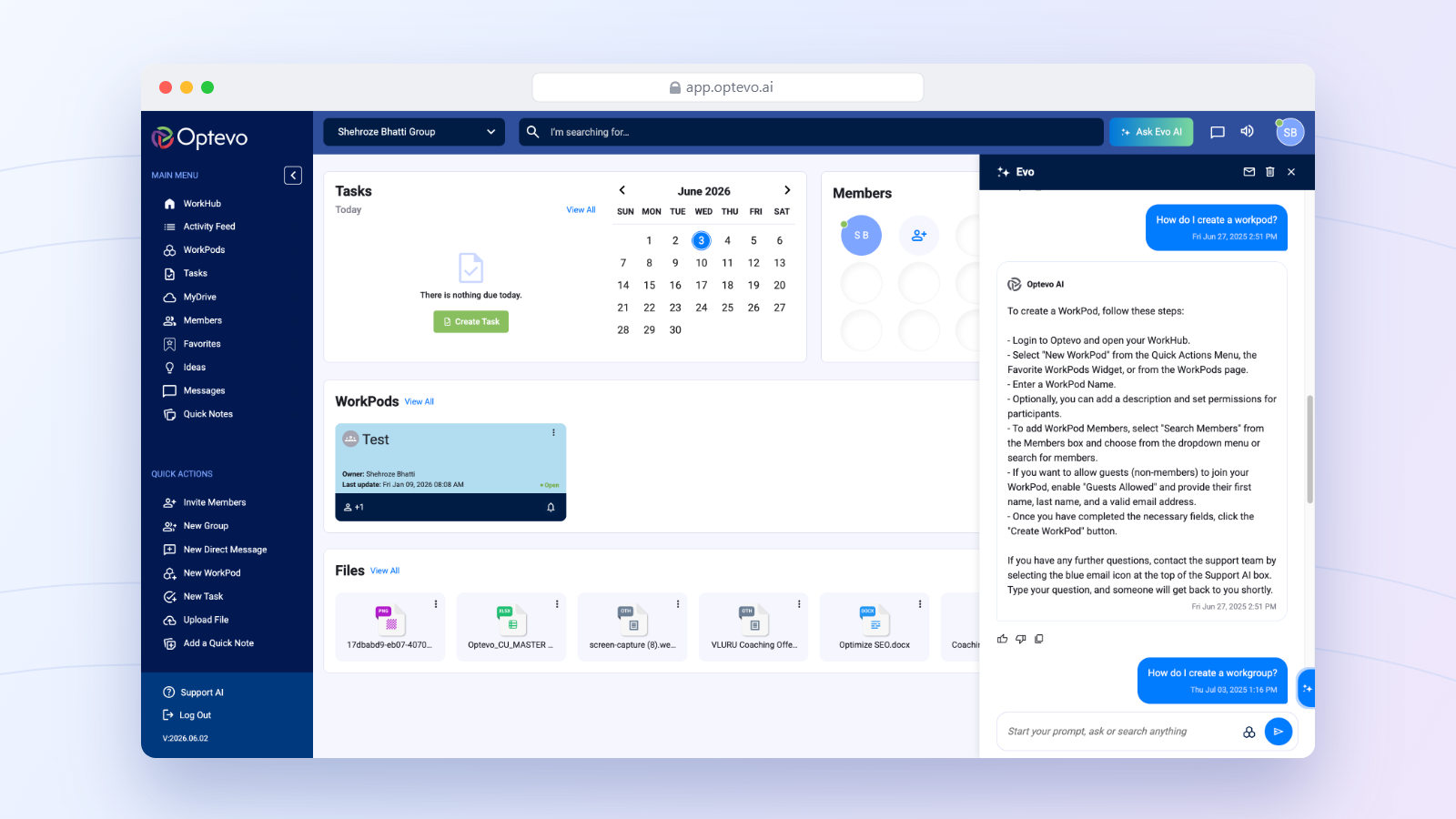
Optevo is a collaborative work platform where distributed teams plan projects, track tasks, and share documents in one place. The product was built around a straightforward premise: teams work better when their planning, communication, and documentation happen in a single, connected environment rather than scattered across tools.
As Optevo’s customer base grew, so did the complexity of what teams were managing inside the platform. More projects, more documents, more threads, more history. The platform was doing what it was built to do — but the sheer volume of accumulated knowledge was creating a new problem. Useful context was getting harder to find, harder to summarize, and harder to keep connected to the work happening in the present.
Optevo’s leadership recognized early that AI wasn’t a feature to add — it was a new architectural layer to build. The goal was a platform where AI understood the team’s work, respected permissions and access boundaries, acted inside the product rather than as a separate tool, and got more useful as the team’s knowledge base grew. That level of transformation required a partner with deep experience in both AI systems and product engineering. That’s where Aegasis Labs came in.
The Challenge
Knowledge Everywhere. Context Nowhere.
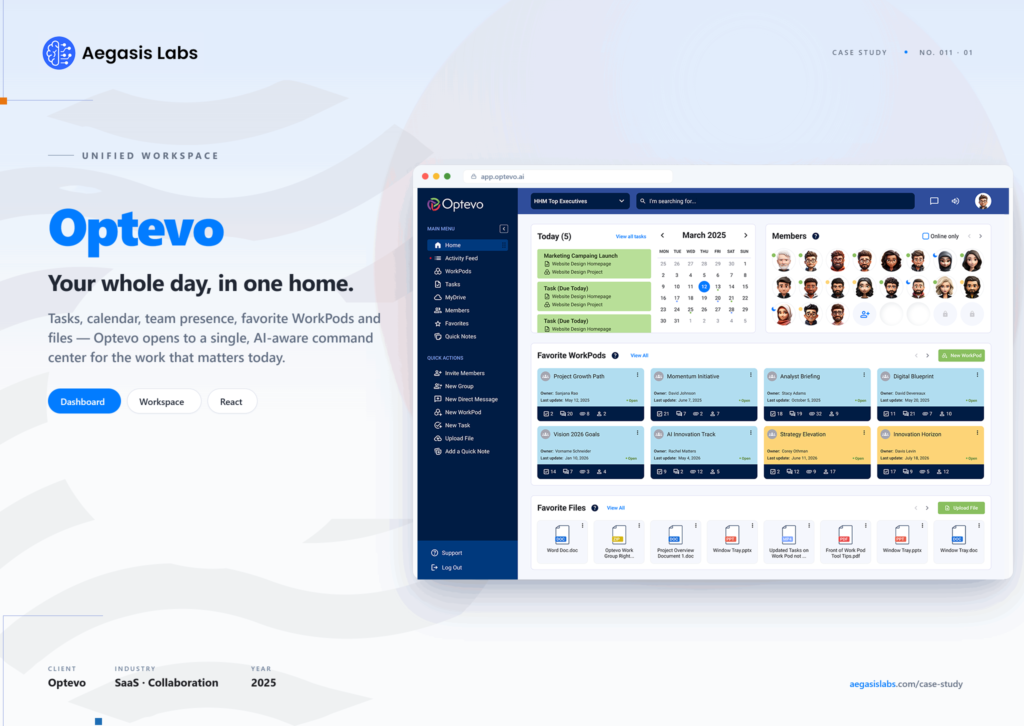
The problem Optevo’s customers described wasn’t a technology failure. The platform worked. Files were stored, tasks were tracked, documents were shared. The problem was that as teams and their knowledge bases grew, the cognitive overhead of working inside the platform grew with them.
Customer feedback kept converging on the same core pain. Knowledge was fragmented. The platform held it but couldn’t surface it. And no amount of better folder structure was going to fix a fundamentally search-and-retrieve problem at scale.
The stakes were real. Every hour a team member spends hunting for a file or re-asking an answered question is an hour not spent on the actual work. Multiply that across a distributed team, across dozens of active projects, and the efficiency cost becomes significant — and entirely invisible in any dashboard.
What Optevo’s customers were asking for wasn’t a smarter search bar. They wanted an assistant that understood the work: one that knew which documents were relevant to a given task, could summarize a long thread in seconds, could draft a status update without being told what was in the project, and could do all of it without stepping outside of Optevo’s security boundaries.
That last requirement was non-negotiable. Any AI layer had to be role-aware, permission-respecting, and safe for enterprise use. A system that surfaced confidential documents to the wrong user — or hallucinated answers with false confidence — would be worse than no AI at all. The solution had to be trustworthy before it could be useful.
The Transformation Brief
Turn Optevo from a platform that stores work into one that understands it — where knowledge surfaces automatically, answers appear in context, and an intelligent assistant helps every user move faster without ever leaving the app.
The additional complexity: this had to be enterprise-safe. Role-based access controls, data isolation between users, PII handling, audit trails for agentic actions, and governance guardrails weren’t optional. Optevo’s customers include teams with real security and compliance requirements. The AI layer had to respect every boundary the platform already enforced — and make those boundaries stronger, not weaker.
The Solution
A Three-Phase AI Strategy That Embedded Intelligence Into the Core Platform
Aegasis Labs designed Optevo’s AI transformation as a structured, multi-phase strategy — each phase building on the last, each delivering user value independently, and each de-risking the next step by proving the architecture before extending it.
The foundation was a RAG-powered retrieval layer built on Azure AI Search and Azure OpenAI, giving the platform the ability to retrieve relevant content from across a user’s workspace and generate contextually grounded, cited answers. On top of that foundation, we built personalized knowledge indexing — a per-user vector store that fuses documents, tasks, and conversation history while enforcing the permission boundaries already in place. The second phase introduced an agentic layer: a proactive assistant that doesn’t just answer questions but can take safe, auditable actions — creating tasks, assigning work, drafting status notes, collecting references — with human-in-the-loop approval at every step.
Phase 1 — Independent AI Features
The first phase introduced AI capabilities that could be used immediately by any Optevo user, without changing how the platform fundamentally worked. The goal was tangible value delivered fast — and proof that AI could be embedded cleanly inside the product’s existing interface.
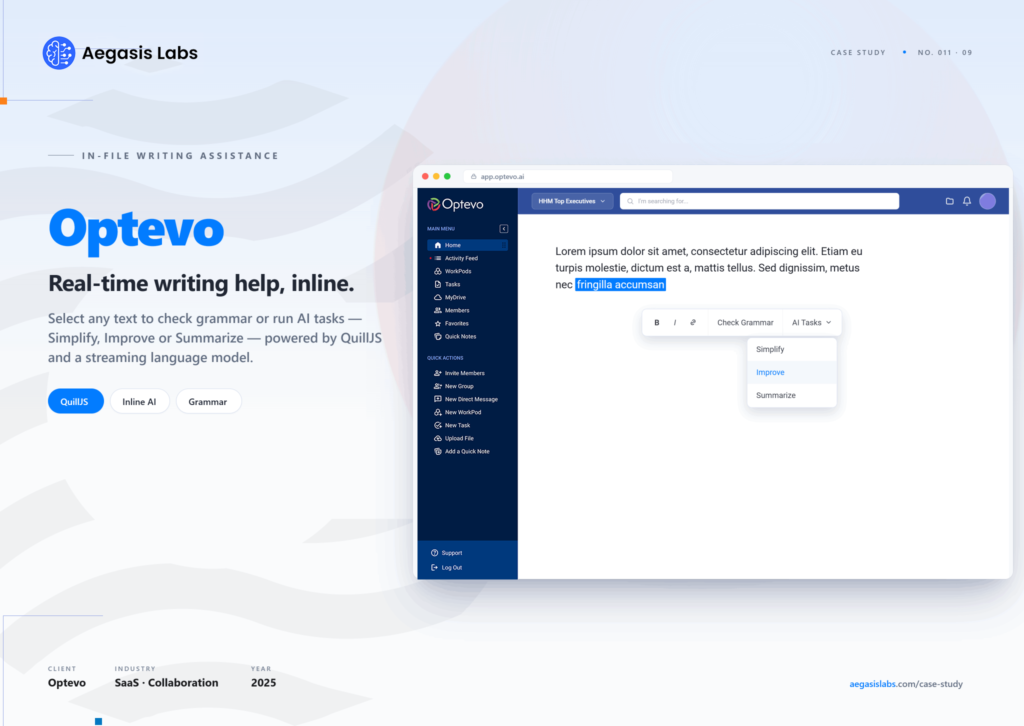
- Writing Assistant. An AI Writing Assistant was embedded directly inside Optevo’s document and task editors. Users could generate first drafts, rewrite sections for clarity, summarize long documents, and surface action items — without leaving the editor or switching to an external tool. The assistant understood the context of what was being written and adapted its suggestions accordingly.
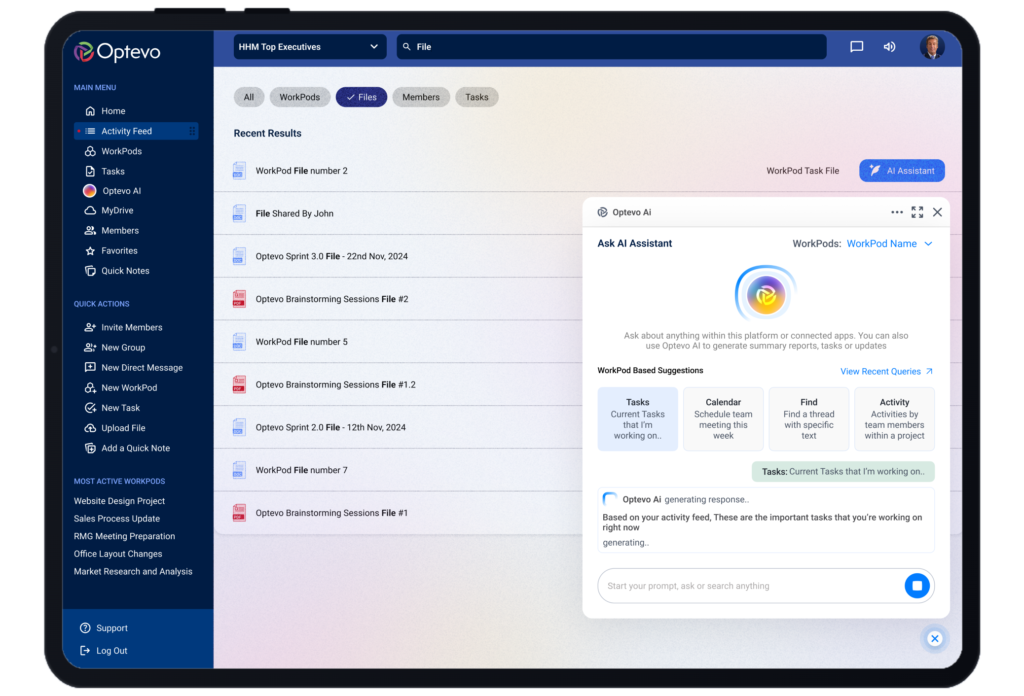
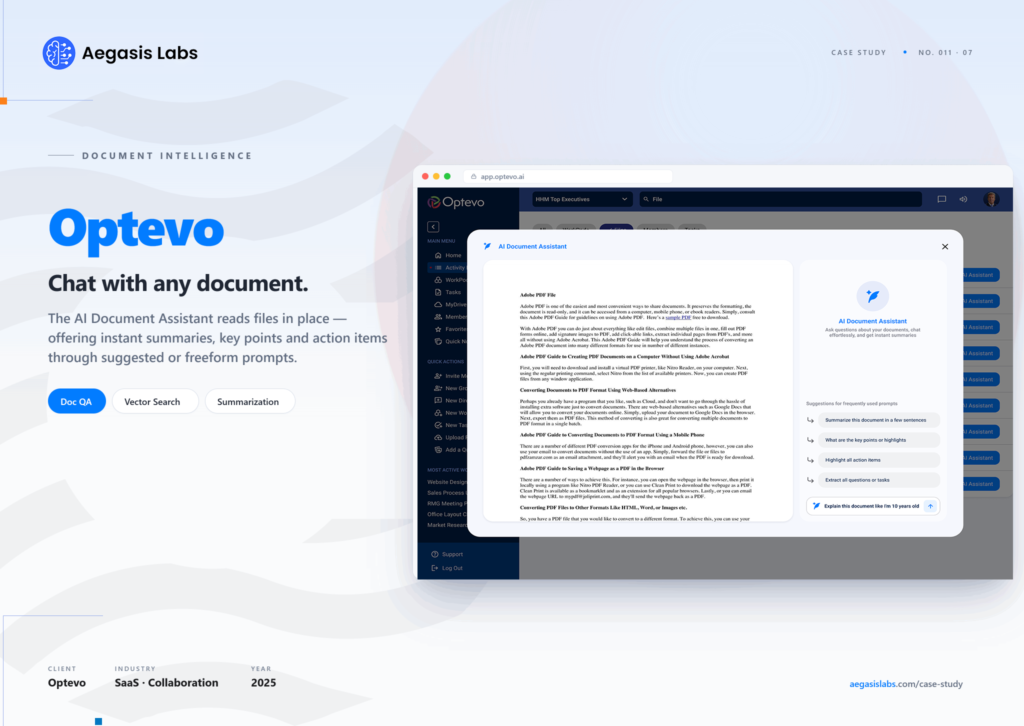
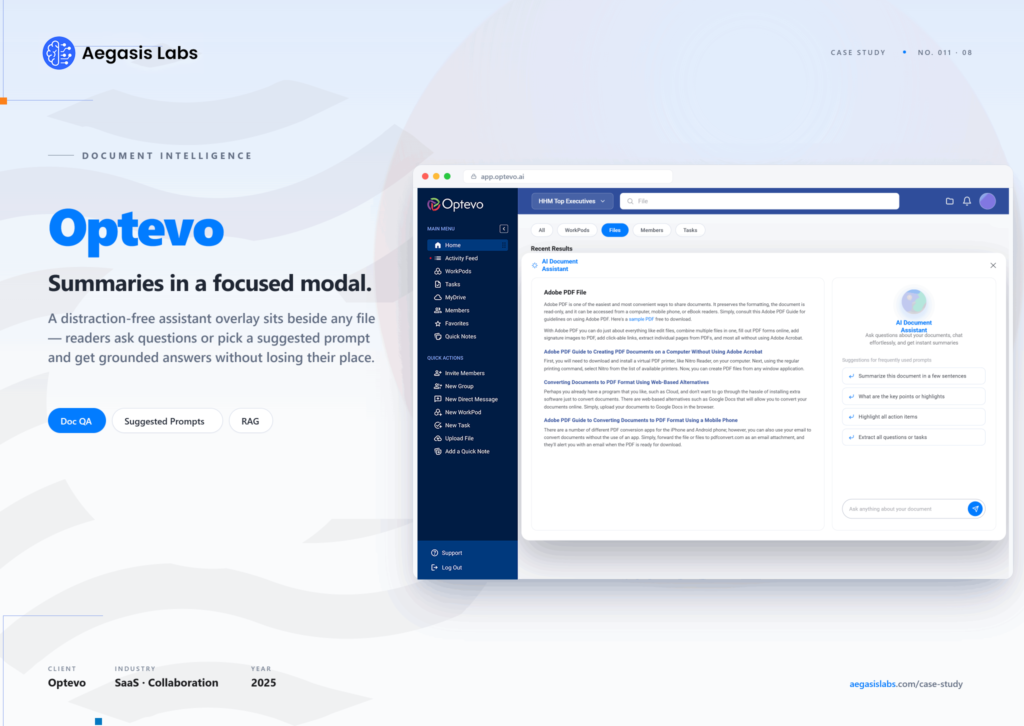
- Document Assistant. A RAG-powered Document Assistant was built on Azure AI Search and Azure OpenAI, giving users the ability to ask natural-language questions about any file open in their workspace. The assistant reads the document in place, returns cited answers and key highlights, and offers structured prompts — summarize this, extract all action items, explain this like I’m new to the project — directly in the file view.
These two features were independent by design. Neither required a new data architecture or a platform-wide knowledge index. They worked on individual documents and tasks, which meant they could be shipped quickly, tested with real users, and iterated on before the deeper transformation began.
Phase 2 — AI-First Platform Transformation
Phase 2 was where the platform’s architecture changed. Rather than AI features sitting alongside Optevo’s core functionality, this phase embedded intelligence into the platform itself — transforming how knowledge was stored, indexed, and surfaced across the entire product.
This phase had two distinct parts, delivered as a coherent system.
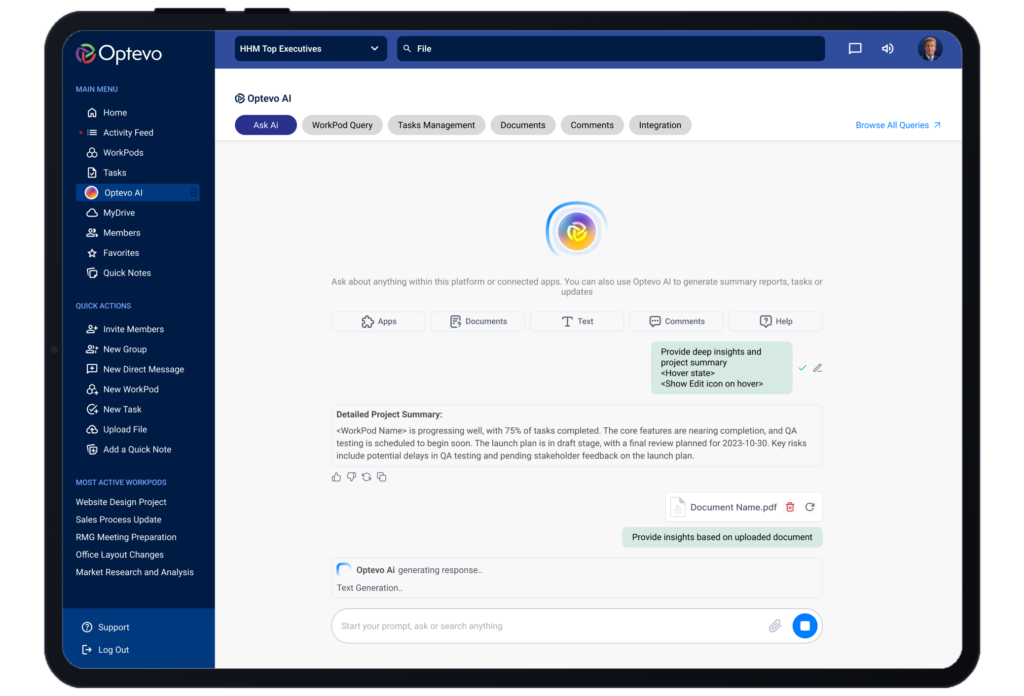
- Knowledge Base. A workspace-wide knowledge base was built on a vector retrieval layer using Azure AI Search. Documents, tasks, messages, and files across each user’s workspace were ingested, chunked, embedded, and indexed — automatically, as content was created or updated. The knowledge base became a living index of everything the team knew, not a static archive that required manual curation.
- Personalized AI Assistant. A Personalized AI Assistant was built on top of the knowledge base, giving every user a private, permission-scoped view of their team’s knowledge. Each person’s assistant only surfaces content they’re authorized to see. It answers questions in context, links responses back to source documents, and understands the current project, role, and task the user is working on — making every answer specific rather than generic.
The combination changed what Optevo was. Previously, a user who needed context had to search for it — opening documents, reading threads, asking colleagues. After Phase 2, the platform already knew the context and surfaced it without being asked. Knowledge became connected to work rather than stored separately from it.
Phase 3 — Agentic AI Workflow Automation
Phase 3 extended the platform from understanding work to actively participating in it. The agentic layer gave Optevo’s AI assistant the ability to take real actions inside the platform — not just answer questions about what should happen, but make things happen — with human approval and a full audit trail at every step.
- Conversational Action. Users can instruct the assistant in natural language to perform actions across Optevo: create a task, assign an owner, update a status, draft a status note, gather references for a project, collect relevant files. The assistant interprets the instruction, identifies what needs to happen, and proposes the action before executing it.
- Human-in-the-Loop. Every proposed action is held for human approval. The assistant surfaces what it intends to do, explains why, and waits for confirmation. No action executes without explicit sign-off. This keeps humans in control of the work while removing the manual effort of doing the mechanical parts of coordination themselves.
- Audit & Governance. Every agentic action is logged in an immutable audit trail — what was proposed, who approved it, what was executed, and when. Administrators have full visibility into every action the assistant has taken, creating the traceability that enterprise teams require when delegating to an AI system.
Phase 3 is what turns the AI assistant from a knowledge tool into a co-pilot. The difference between answering ‘who should own this task?’ and actually assigning it is the difference between a reference tool and a system that helps teams move faster.
What Was Built
- AI Writing Assistant: Generative AI writing support embedded in document and task editors — drafting, rewriting, summarizing, and surfacing action items in context, without the user leaving their current workspace.
- RAG Document Assistant: Azure AI Search and Azure OpenAI powering in-place document Q&A, with cited answers, key point extraction, and structured prompts accessible directly inside any open file.
- Workspace Knowledge Base: A continuously updated vector index of documents, tasks, messages, and files across the workspace — ingested automatically as content is created, chunked semantically, and retrievable in real time.
- Personalized AI Assistant: Per-user permission-scoped knowledge views that power contextual Q&A, source-linked answers, and proactive knowledge surfacing — tailored to each user’s role, projects, and current work.
- Agentic Workflow Automation: Natural language task orchestration that interprets user instructions, proposes specific actions across Optevo, and executes them after human approval — covering task creation, assignment, status updates, and reference gathering.
- Governance & Safety Guardrails: Prompt and response validation, PII controls, role-based access enforcement, and data isolation built across all three phases — ensuring the assistant operates within the same permission boundaries the platform enforces.
- Audit Trails & Compliance: Immutable logs for every agentic action with full traceability — what was proposed, who approved it, and what was executed — meeting the auditability standards enterprise teams require.
- Observability & Evaluation Tooling: Telemetry for response quality, latency, cost, and adoption across all AI features — with evaluation pipelines that support continuous improvement rather than a one-time release.
Technologies The platform was built on a modern, production-grade stack selected for reliability at scale:
- Azure AI Search for vector retrieval and hybrid semantic search across user knowledge indexes
- OpenAI (GPT models) for reasoning, summarization, generation, and agentic orchestration
- Azure Functions and event-driven services for document ingestion, embedding generation, and workflow orchestration
- Azure Storage for document assets and embeddings metadata
- TypeScript and React components for embedding the assistant directly into Optevo’s existing UI
- Role-based access control, encryption at rest and in transit, PII controls, and structured telemetry across the full stack
The entire AI stack was built to integrate with Optevo’s existing framework — not alongside it. The assistant lives inside the product because it was engineered to be part of it, not because a third-party chatbot was connected to it externally. That architectural decision is what makes the experience feel native rather than bolted on.
How We Worked Together
A product transformation of this scope — AI strategy, independent feature delivery, platform-level knowledge infrastructure, and an agentic automation layer — couldn’t be delivered as a single monolithic build. Aegasis Labs structured the engagement as a three-phase delivery, with each phase scoped to deliver standalone user value while laying the foundations for the next.
- Discover — We mapped Optevo’s existing architecture, user workflows, and knowledge pain points to design an AI strategy aligned to their product roadmap and enterprise requirements.
- Design — We produced a phased solution blueprint covering retrieval architecture, personalization logic, agentic automation, and governance — with clear milestones for each phase.
- Build — Our engineering team delivered across the full stack: Azure AI infrastructure, per-user indexing, embedded UI components, and the agentic workflow layer — in two structured phases with minimal disruption to the existing product.
- Scale — We shipped with observability, autoscaling, and evaluation tooling built in — so the platform is optimized from day one and positioned to grow with Optevo’s customer base.
The Results
An AI-First Platform. Built Into the Product. Not Next to It.
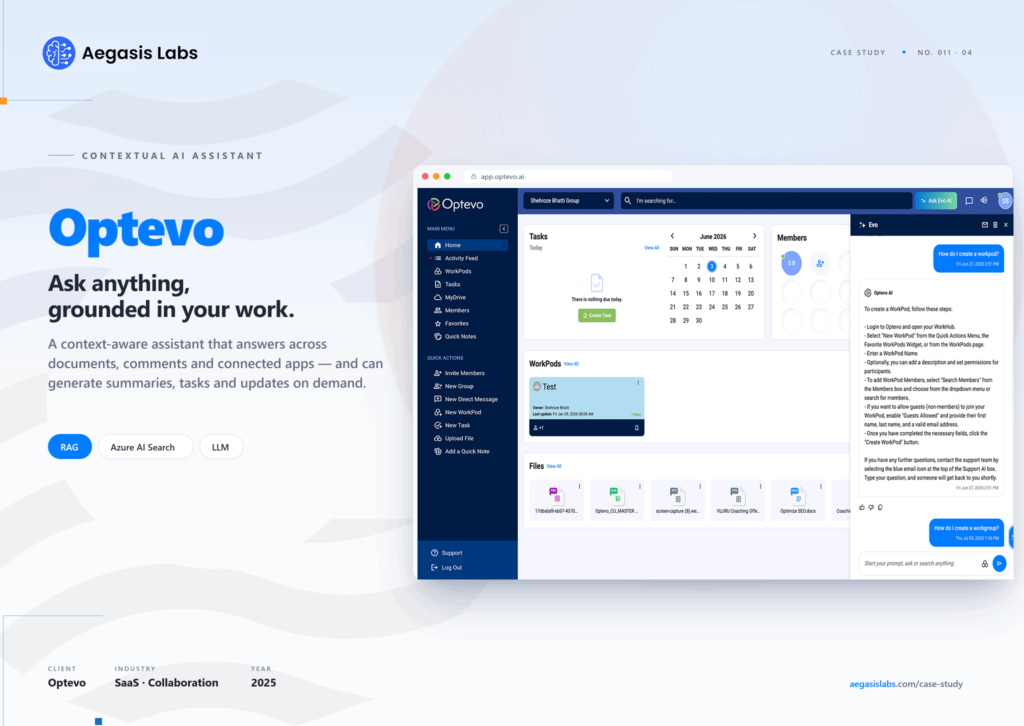
Optevo’s platform now ships with a native AI co-pilot that meets enterprise standards for privacy, access control, and auditability. The transformation wasn’t a feature addition — it was an architectural shift in what the product is and how it serves its users.
What Optevo’s Platform Delivers Now
A native AI writing assistant and document Q&A tool for immediate user value; a permission-safe, personalized knowledge layer that understands the team’s work; and an agentic assistant that can take auditable actions across the platform — all three phases embedded directly into Optevo’s core product.
The outcomes span the full user journey from knowledge retrieval through active work coordination:
Knowledge that surfaces in the flow of work. Users ask natural language questions inside task views and documents and receive cited answers grounded in their own workspace content — without leaving Optevo to search, summarize, or piece together context from scattered sources.
A private knowledge index for every user. Each person’s assistant is powered by a vector index scoped to their role and permissions. The assistant sees what they see — nothing more. Answers are specific to their current projects and team, not generic responses drawn from a shared pool of unscoped content.
- Less context-switching across the workday. Work that previously required moving between search tools, document folders, and task boards now happens in a single place. The cognitive overhead of reassembling context before doing work is largely eliminated for users who have adopted the assistant.
- Better quality writing and communication. In-document writing support helps teams produce clearer status updates, action items, and summaries — directly in the editor, without interrupting the writing flow to gather information from elsewhere.
- Safe, auditable automation. The agentic layer allows users to delegate routine coordination — task creation, assignment, status updates, reference gathering — to the assistant, with every proposed action reviewed and approved before it executes. Teams move faster without losing control.
- Enterprise-grade security by design. Access controls, data isolation, PII handling, and audit trails aren’t policies applied on top of the AI layer — they’re built into its architecture. The assistant enforces the same permission boundaries the platform enforces, consistently and automatically.
- A Native AI Co-Pilot. Enterprise-Ready. Embedded in the Product:
The Optevo platform now ships with an AI-powered knowledge assistant that meets enterprise standards for privacy, accuracy, and control — built directly into the product experience, not layered on top of it. - 99% uptime, built to scale.
The cloud architecture was designed for reliability and elasticity from day one. Autoscaling handles growth; the infrastructure optimizes to demand. Optevo’s customers get a consistent, performant experience whether the team is five people or five hundred. - Less context-switching across the workday. Work that previously required moving between search tools, document folders, and task boards now happens in a single place. The cognitive overhead of reassembling context before doing work is largely eliminated for users who have adopted the assistant.
- Instant document help, inside the workflow.
Users search across files, get smart summaries, and draft content without leaving Optevo. The work that used to require jumping between search tools, notes apps, and task boards now happens in one place — in seconds. - Personal knowledge for every user.
Each team member has a private, permission-aware index of their files, tasks, and messages. Questions get answered with cited, contextually grounded responses — not generic outputs that ignore who’s asking or what they’re allowed to see. - Dramatically less context-switching.
The coordination overhead that quietly drains distributed teams — re-asking answered questions, rewriting status updates, hunting for the right document — is handled by the assistant. Users get from question to answer faster, and stay in the flow of work longer. - Better writing, less effort.
Better quality writing and communication. In-document writing support helps teams produce clearer status updates, action items, and summaries — directly in the editor, without interrupting the writing flow to gather information from elsewhere. - An agentic layer that moves work forward.
The agent doesn’t just retrieve — it acts. Task creation, assignment, and updates happen through the assistant with human approval and full audit trails. Routine coordination work that required manual back-and-forth is increasingly handled by the co-pilot. - Enterprise-grade security by design. Access controls, data isolation, PII handling, and audit trails aren’t policies applied on top of the AI layer — they’re built into its architecture. The assistant enforces the same permission boundaries the platform enforces, consistently and automatically.
- A foundation for continuous improvement.
The RAG and agent architecture is extensible by design. New tools, domain skills, and deeper workflow automations can be added as adoption grows — without rebuilding the foundation. Observability tooling tracks quality and usage continuously, enabling the Optevo team to improve the system based on real data, not assumptions.
What Aegasis Labs delivered isn’t a feature. It’s a platform transformation — one that repositions Optevo from a place teams store their work to a system that actively helps them do it.
Build Your AI Product with Aegasis Labs
The Optevo transformation shows what’s possible when AI strategy and engineering expertise work together — building systems that are intelligent, trustworthy, and genuinely embedded in how users work.
Aegasis Labs has delivered 70+ projects across 8+ industries, with a 97% project completion success rate and 95% client satisfaction. Our 30+ consultants bring top 1% technical expertise across AI, cloud, and software — and we’re a certified partner of both AWS and Microsoft.
If your product needs an AI layer that users will actually trust — or if your operations need the kind of intelligent automation that moves the needle — we’d love to talk.
Ready to Make Your Product AI-First?
If you’re building an intelligent product or transforming an existing platform with AI, visit aegasislabs.com to start the conversation about what a structured, phased AI strategy could look like for your business.