

Executive Summary
Healthcare organizations that handle workers’ compensation and medical case management operate under a particular kind of pressure. The volume of documentation is relentless. Referral packages arrive by fax and email, often as image PDFs scanned from paper originals. Medical records run to hundreds of pages. Case handlers review all of it manually, extract the details that matter, enter them into case management systems by hand, and then file the documents in the right place against the right case record. Every step of that process is slow, prone to error, and entirely dependent on human attention.
Our client is a California-based rehabilitation services organization working with insurance carriers, third-party administrators, and self-insured employers across industries including public agencies, school districts, utility providers, and retail. The volume and sensitivity of the documentation they manage is significant. Protected health information flows through their systems at high volume, governed by strict compliance requirements and handled through a proprietary case and document management platform that has been the operational backbone of the organization for years.
Aegasis Labs partnered with this organization across four interconnected workstreams: automating the referral and document intake process end-to-end, building an AI summarization system for lengthy medical record PDFs, scoping a cloud migration and failover architecture for their existing infrastructure, and delivering a strategic AI and technology roadmap with Power BI reporting recommendations. The result was a system that removed manual document handling from the intake workflow, reduced the time case handlers spend reviewing medical records, and gave the organization a clear technology path forward.
About the Client
Our client provides rehabilitation case management and referral coordination services across California, working with a diverse base of insurance carriers, third-party administrators, and self-insured employers. Their client industries span public agencies, school districts, utility providers, and retail organizations — a range that reflects both the breadth of their service capability and the variety of documentation and compliance requirements they navigate daily.
At the center of their operations is iRWI, a proprietary case and document management application built on ASP.NET Webforms, running on a VMware Windows server with SQL Server as the data layer. iRWI is the system of record for sensitive protected health information across a high volume of medical and referral documentation. It works. It has worked for years. But the workflows built around it had grown increasingly manual as referral volumes increased and the organization took on a more complex client mix.
The organization came to Aegasis Labs with a clear need: modernize how referral and medical documentation flows into iRWI, apply AI where it could meaningfully reduce manual effort, and think clearly about where the technology needed to go over the next few years. That last part mattered as much as the automation itself. This wasn’t a client looking for a single fix. They wanted a partner who could look at the full picture and help them understand what they didn’t yet know they were missing.
The Challenge
Manual Workflows in a High-Volume, High-Stakes Environment
Workers’ compensation and medical case management don’t allow for slow information processing. A referral that sits unprocessed, a medical record that doesn’t reach the right case handler in time, a document filed against the wrong case record — any of these has downstream consequences for the patient, the employer, and the carrier. The cost of documentation errors in this environment isn’t abstract.
The intake process the organization relied on had several specific failure points, each compounding the others.
Referrals arrived as faxed image PDFs, flat files with no extractable text, requiring a person to read them, manually pull the relevant data, and key it into iRWI to create a new case record. That process was not just slow, it introduced transcription risk at every step. A misspelled name, a transposed date, a wrong case number — in a PHI-handling environment, these are compliance events, not minor inconveniences.
Medical records arriving alongside referrals were often substantial. Three hundred pages is not unusual. A case handler reviewing a 300-page medical record to extract the specific clinical data points relevant to a case is spending significant time on a task that is largely mechanical. Finding the treatment history, the diagnosis, the relevant dates, the attending physician notes — these are identifiable targets buried in dense documentation. It is exactly the kind of work that is exhausting for a skilled professional to do repeatedly, and exactly the kind of work where AI can create real leverage.
Beyond intake, the organization’s infrastructure carried its own risk. A VMware Windows server environment without a tested failover architecture is a single point of failure. In an organization managing sensitive patient data and time-sensitive referral workflows, unplanned downtime is not a recoverable situation without significant disruption.
Finally, and perhaps most importantly, the organization lacked a clear view of its own operational data. Without structured KPI dashboards, management visibility into case volumes, referral throughput, processing times, and bottlenecks relied on manual reporting that was slow to produce and difficult to act on.
Each of these problems was manageable in isolation. Together, they formed a picture of an organization whose operational infrastructure had not kept pace with its growth or its compliance obligations.
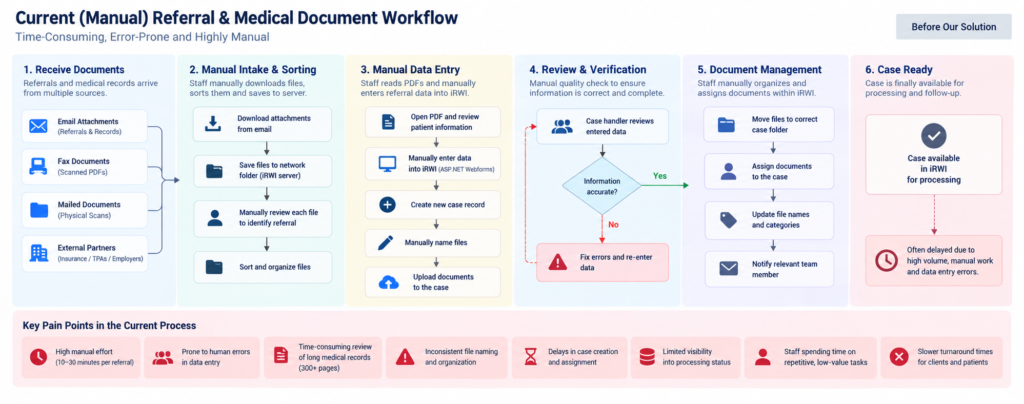
Here’s what the team was dealing with every day:
- Medical PDFs arriving in every format imaginable
Referrals come in via email. Many originate as faxes — flat image files that no system can read as text. Before anyone could use the data inside them, someone had to process each document by hand. - Manual case creation from incoming referrals
Every new referral meant manually extracting the key data, opening iRWI, creating a case record, and populating it field by field. Repetitive, error-prone, and time-consuming at scale. - Medical records that run to hundreds of pages
Case handlers reviewing a 300-page medical record to extract the handful of clinical data points they actually need — that’s not a good use of anyone’s time. And it adds up quickly across a full caseload. - Infrastructure with no failover
A single VMware Windows server environment means one point of failure. If the primary system goes down, operations stop. For an organization handling PHI at volume, that’s a serious risk. - No visibility across operations
Without dashboards or structured reporting, understanding case volume, referral trends, and operational KPIs required manual data pulls and guesswork. None of these problems were unique. But together, they were holding the organization back — and none of them had an obvious fix inside the existing setup.
The Solution
Aegasis Labs approached this engagement as a strategic partner, not a feature vendor. Before building anything, we conducted a full review of the iRWI system and the organization’s existing operational workflows. That discovery produced both the automation roadmap and a broader strategic assessment surfacing technology opportunities the organization had not yet identified internally. Everything that followed was built on that foundation.
Referral and Intake Automation
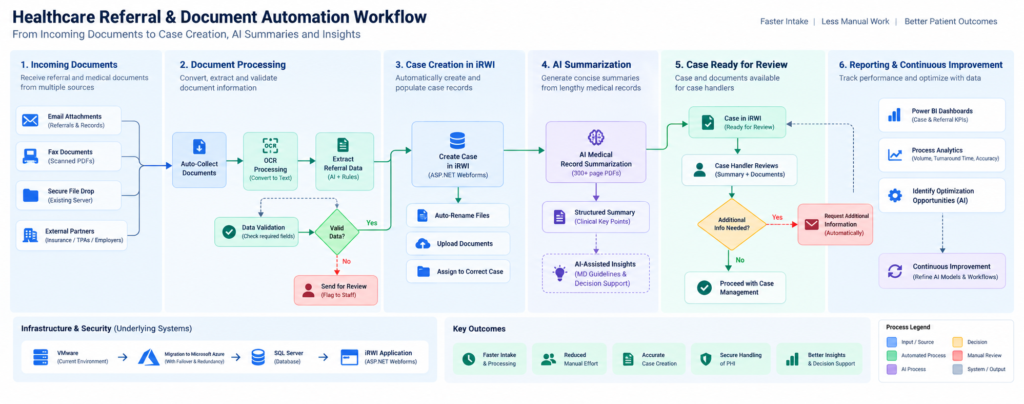
The intake workflow was rebuilt end-to-end. Referral and medical PDF files arriving via email and the existing Windows server are now collected automatically, with no manual monitoring required. Fax-originated image PDFs go through an OCR pipeline that converts flat image files into readable, structured text PDFs before anything else happens. That conversion step is what makes everything downstream possible.
From the structured text, referral data is extracted automatically and used to create and populate new case records directly inside iRWI. The converted medical PDFs are then renamed, uploaded, and assigned to the correct case record automatically. The entire sequence that previously required a person to read a fax, transcribe data into the system, and file the document by hand now runs without manual intervention.
The practical impact on the intake workflow was substantial. Transcription risk at the point of data entry is eliminated. Documents reach the right case record consistently. Case handlers begin their work on a case that has already been created and populated, rather than spending time on the administrative steps that precede it.
AI Medical Record Summarization
For the medical record review problem, we built an AI summarization workflow using LLM-based document processing. The system ingests multi-hundred-page medical record PDFs and produces concise, focused paragraph summaries that prioritize the specific clinical data points case handlers rely on most.
The summarization was tuned to the organization’s actual use case, not to a generic document summarization task. What a case handler needs from a 300-page medical record is not an equal-weight summary of every page. It is a clear, organized extract of the treatment history, diagnosis, relevant dates, and clinical findings that matter to the case. The AI system was configured to surface that information specifically, in a format that fits naturally into how case handlers read and act on medical records.
The time reduction on medical record review is meaningful. A task that required a skilled professional to spend significant time reading and extracting information from dense documentation now produces a usable summary in seconds, with the full record available for reference when deeper review is warranted.
Cloud Migration and Infrastructure Resilience
The organization’s VMware Windows server environment was scoped for migration to Microsoft Azure. Alongside the migration plan, we designed a failover architecture with a continuously mirrored, redundant server to ensure availability if the primary system fails. In an environment managing PHI and time-sensitive referral workflows, that redundancy isn’t an optional enhancement. It is the difference between a recoverable incident and a compliance event.
The migration and failover design provides the organization with a clear, actionable path from their current infrastructure to a cloud-native environment that matches the resilience requirements of the work they do.
AI Strategy Roadmap and Business Intelligence
The strategic assessment delivered technology improvement recommendations spanning AI, Power Automate, and OCR across the organization’s operations. Specific advisory work covered AI-assisted medical decision support and the potential for AI-generated MD guideline documentation, two areas where the organization’s case volumes create clear leverage for intelligent automation beyond the intake workflow.
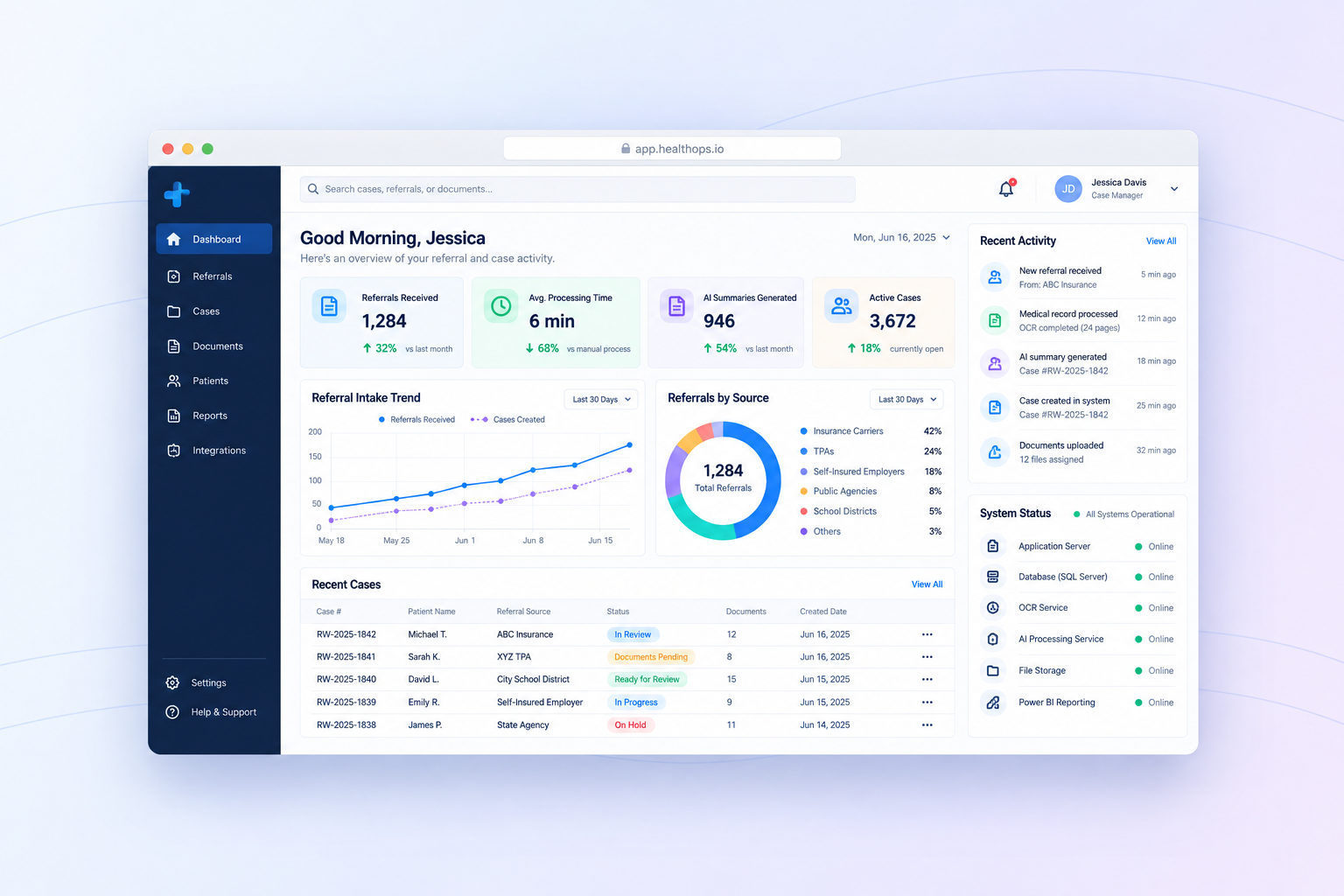
Power BI dashboards were scoped to track core business KPIs across the organization’s case and referral operations, giving management a real-time view of throughput, processing times, case volumes by type, and the operational metrics that currently require manual reporting to surface.
Technologies Used
- Platform
- ASP.NET Webforms (iRWI)
- NET, SQL Server
- Infrastructure
- VMware
- Microsoft Azure (migration & failover)
- Automation
- Power Automate
- OCR
- AI & Data
- AI/LLM-based document summarization
- AI-assisted decision support
- Reporting
- Power BI
How We Worked Together
The engagement followed Aegasis Labs‘ Discover, Design, Build, Scale delivery model. The discovery phase was particularly important here because the four workstreams, while distinct, had to be sequenced and designed as a coherent system rather than four independent projects.
We started with a full review of the iRWI platform and the organization’s existing workflows, understanding how documentation actually moved through the system, where human effort was being spent on tasks that followed repeatable logic, and where the infrastructure carried risk. That review shaped both the automation scope and the strategic roadmap that accompanied it.
The OCR and intake automation was designed first, because it was the foundation everything else depended on. Structured text extraction from incoming PDFs was the prerequisite for automated case creation, document assignment, and AI summarization. Getting that layer right before building on top of it was essential.
The AI summarization system was built and tuned in close collaboration with the case handlers who would use it, ensuring that the output matched their actual workflow rather than a theoretical ideal of what a medical record summary should look like.
The cloud migration scope and Power BI recommendations were delivered as a strategic roadmap alongside the automation build, giving the organization a clear view of where their technology needed to go next and a sequenced plan for getting there.
The Results
The automation system and AI summarization workflow are live within the organization’s operations. The outcomes map directly to the problems the engagement was built to solve.
Manual document handling at intake has been removed from the workflow. Referrals arriving as faxed image PDFs go through the OCR pipeline, yield structured text, generate case records in iRWI automatically, and route converted documents to the correct case record without a person touching them. The transcription errors and document filing inconsistencies that came with manual intake are eliminated by design.
Medical record review is faster. Case handlers working with lengthy medical records now start from an AI-generated summary tuned to the clinical data points they actually need, rather than reading through hundreds of pages to extract a set of specific facts. The full record remains available for deeper review when needed. The time previously spent on the mechanical parts of that review is available for the judgment-dependent work that skilled case managers are actually hired to do.
The strategic roadmap and infrastructure resilience plan give the organization a clear technology path forward. The Azure migration scope and failover architecture address the infrastructure risk that existed in the previous environment. The AI advisory work on decision support and MD guideline documentation identified opportunities for further automation that the organization can pursue in sequence. The Power BI dashboard scope provides a roadmap to operational visibility the organization currently has to construct manually.
- Referral intake is now fully automated
PDFs arrive, get processed, converted, and assigned to the right case records in iRWI — without anyone in the loop. The manual document handling that used to eat hours of the team’s day is gone. - 300-page medical records become paragraph summaries
Case handlers get the clinical data points that matter, extracted and organized by AI, in a fraction of the time it used to take. Consistency improves. Review time drops sharply. - A technology roadmap the organization didn’t have before
The discovery engagement surfaced AI, automation, and infrastructure opportunities that weren’t on anyone’s radar internally. The team now has a clear picture of where to go next and why. - Infrastructure designed to stay up
The Azure migration scope and failover architecture means the organization is on a path to redundancy it didn’t have. One server failure no longer means operations grind to a halt. - Operational visibility through Power BI
Dashboard scoping gives the leadership team a path to real-time KPI tracking across case and referral operations — the kind of visibility that makes management decisions faster and more grounded.
Build Your Healthcare Automation System with Aegasis Labs
This organization came to us with a documentation problem that was costing their team significant time every day and introducing compliance risk at the point of manual data entry. The solution wasn’t a new case management platform or a larger team. It was intelligent automation built precisely around the workflows and systems they already had, with a strategic layer that helped them see what else was possible.
That is what Aegasis Labs brings to healthcare and regulated industry engagements. We understand how to build automation that works inside existing systems rather than replacing them, how to apply AI to the specific data extraction and summarization tasks that consume skilled professionals’ time, and how to deliver a technology roadmap that makes the next step clear.
When you automate intake, apply AI to document review, and build the infrastructure foundation to support it all, the compounding effect is real. Case handlers focus on cases instead of paperwork. Errors from manual data entry don’t make it into records. Medical record review that used to block decisions happens in minutes.
Start a conversation with our team
We’re a certified AWS and Microsoft partner with 70+ projects delivered across 8+ industries — including healthcare, finance, and enterprise technology.
Explore our Enterprise AI Automation services →See our engagement models