

Executive Summary
Online shopping has a discovery problem. Not a product problem — most stores carry exactly what their customers want. The problem is getting shoppers from question to the right product before they give up and go somewhere else.
Cressi was founded to solve that. Their vision: an AI-powered personal shopping assistant that sits inside any e-commerce store, understands natural language questions, and responds the way a knowledgeable sales associate would — not with 200 filtered results, but with a direct, helpful answer.
To build it, Cressi partnered with Aegasis Labs. We designed and delivered the full platform — AI engine, backend infrastructure, frontend chat widget, and cloud deployment — from concept to production. The result is a purpose-built Retrieval-Augmented Generation system that retrieves real product data before generating any response, so shoppers get answers grounded in actual catalog facts, not hallucinated guesses.
About Cressi
Cressi is an AI-powered personal shopping assistant designed for e-commerce merchants who want to give customers a better discovery experience — without rebuilding their entire tech stack.
The founding idea was disarmingly simple: let shoppers ask questions the way they’d ask a friend. Show me jackets under $100. Which size should I pick? What goes with these shoes? Most stores can’t answer those questions. Cressi can.
Their customers are e-commerce merchants. Their users are everyday shoppers — people who know roughly what they want but don’t want to earn it through keyword boxes and filter menus. The platform is designed to slot into any existing store and work immediately, with no friction on either side of the transaction.
Bringing that vision to life meant building something that didn’t exist off the shelf. Cressi needed a technical partner to design, build, and deploy the entire system end-to-end. That’s where Aegasis Labs came in.
The Challenge
E-commerce search hasn’t meaningfully changed in two decades. Type a keyword, get hundreds of results, apply filters, scroll through pages, open tabs, compare specs, check sizing guides, get confused, abandon the cart. The tools have gotten faster. They haven’t gotten smarter.
None of them understand what a shopper actually means.
When someone types “something warm but not too bulky for a night out,” a keyword search returns results for “warm jacket.” That’s not the same thing. The gap between those two answers is where cart abandonment lives — and it’s expensive. Shoppers who can’t find what they need fast enough don’t just leave that session. They’re less likely to return. They go tell support teams questions that shouldn’t require a support ticket. They buy from someone whose store was easier to navigate.
Stores with large, frequently changing catalogs carry the most exposure here. The bigger and more dynamic the catalog, the harder keyword search works and the worse its results get. Scale makes the problem worse, not better.
There’s also a compounding cost that’s easy to miss. Every repetitive product question hitting a support inbox is a question a well-designed AI assistant could have answered in two seconds. Every shopper who left because they couldn’t find the right size variant is a conversion that required no discount to win — just a direct answer.
Shoppers aren’t asking for better filters. They’re asking someone to just tell them what they want to know and point them to the right product. Every store that can’t do that is leaving money on the table, every single day.
The Solution
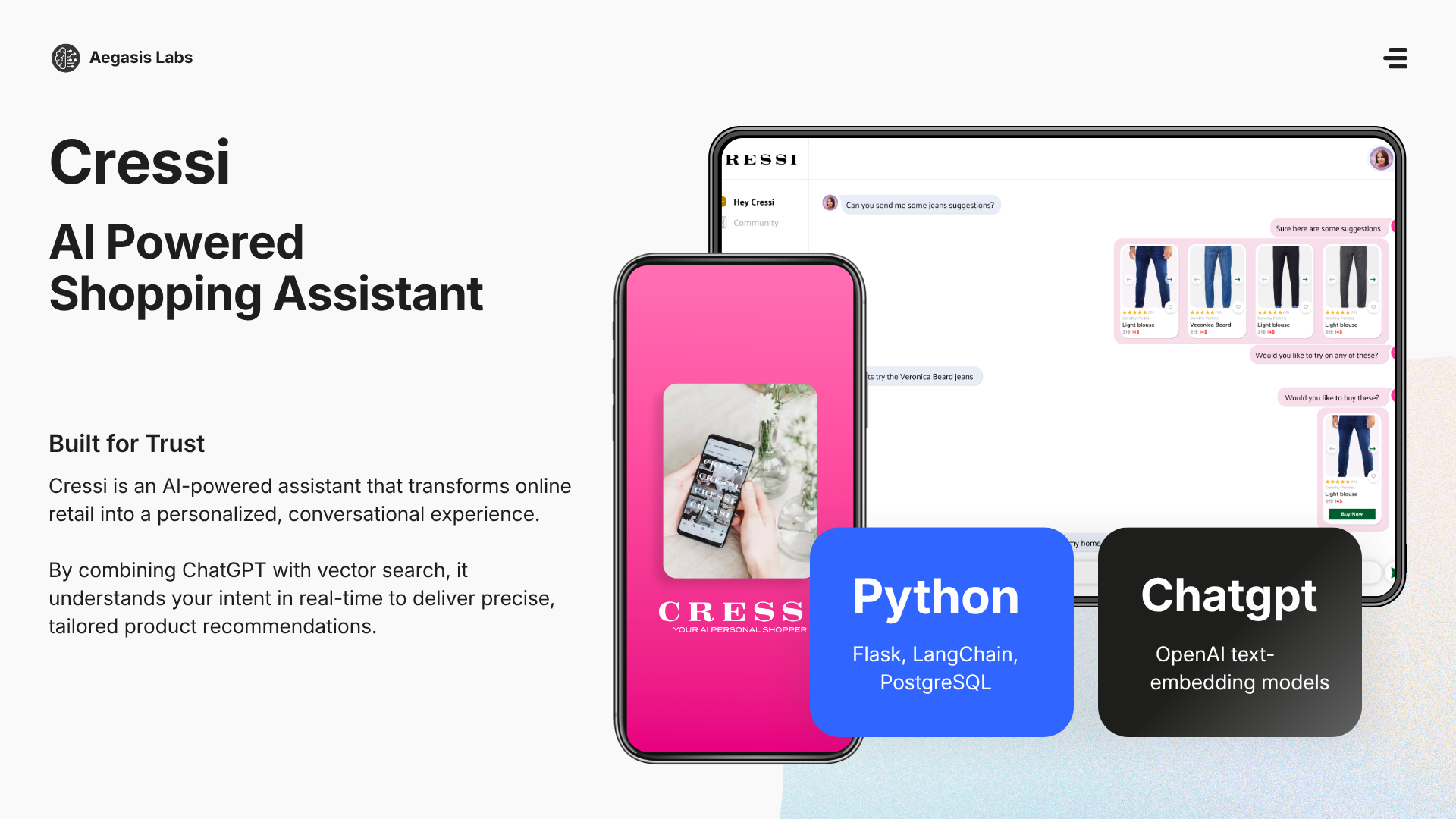
Aegasis Labs designed and built the Cressi AI shopping assistant from scratch. Not a chatbot template with product data injected — a purpose-built AI system designed around how shoppers actually behave and what e-commerce operators actually need to manage.
The technical foundation is Retrieval-Augmented Generation. Before the AI writes a single word of response, it retrieves accurate, up-to-date product information directly from the store’s catalog. GPT-4 generates the response. LangChain orchestrates the pipeline. Pinecone handles the vector store, enabling fast semantic retrieval across catalogs of any size. The architecture means answers are grounded in real data — not generated from memory, not guessed.
How It Works
A shopper asks a question in plain language — exactly as they’d phrase it to a person.
- The NLP layer interprets the intent behind the question, not just the words in it, and queries the vector store for semantically relevant products and attributes.
- The RAG pipeline retrieves the right catalog data — product details, variants, specs, pricing, availability — and passes it to GPT-4 to compose a response.
- The shopper receives a direct, conversational answer with relevant products, comparisons if useful, and in-chat actions (add to cart, set a back-in-stock alert, go to the product page) without ever leaving the conversation.
- Session memory retains preferences — size, style, budget, items already viewed — so suggestions sharpen with each exchange rather than starting from zero every time.
What Was Built
- Natural product Q&A and search: Free-text questions mapped to the right products, variants, and attributes using RAG. The assistant understands what shoppers mean, not just what they typed.
- In-session personalisation: Preferences captured across the conversation — size, budget, style signals, past views — used to make each subsequent suggestion more relevant without prompting the shopper to repeat themselves.
- Smart product comparisons: Side-by-side pros, cons, and key specs generated on demand when a shopper is deciding between similar items. Real data, not generic copy.
- Cart and action helpers: Add to cart, back-in-stock alerts, and direct product page links all accessible from inside the chat. The shopper never needs to leave the assistant to act.
- Confidence-based fallbacks: When the AI’s confidence in an answer is low, it asks a clarifying question rather than returning something wrong. The assistant knows what it doesn’t know.
- Admin tooling: Catalog upload, re-indexing, response review, and A/B experimentation for prompts and UI — all manageable by the merchant team without engineering involvement.
Technologies The platform was built on a modern, production-grade stack selected for reliability at scale:
- AI & Retrieval: Large Language Models (GPT-4), LangChain, RAG, Pinecone (vector store), NLP models
- Backend & APIs: Python, Python Flask
- Frontend: Angular (web app & chat widget)
- Cloud & DevOps: AWS (ECS, S3, CloudFormation), AWS services for scaling/observability
- Other: GPT-4 prompt orchestration, analytics & feedback loops
The Results
The Cressi platform shipped as a production-ready AI shopping assistant — fully deployed, tested with real users, and iterated on the basis of actual shopper behavior before launch.
After rollout and real-world iteration with user feedback, the Cressi platform delivered measurable outcomes across every dimension that matters to an e-commerce team.
- Reliable, scalable system: Deployed on cloud infrastructure with auto-scaling so the chatbot stays responsive during traffic spikes and works 24/7.
- Better answer quality over time: NLP + fine-tuning and comparative evaluation loops improved intent detection and the relevance of answers as more conversations came in.
- Fast responses: Typical answers are generated in seconds, keeping users engaged and reducing drop-off.
- Clear guidance with guardrails: The bot provides human-like explanations, highlights key legal concepts, and includes safe-use messaging (not a substitute for a lawyer) to set the right expectations.
- Broad coverage of common topics: From contracts and employment to consumer and small-business queries, the chatbot can handle a wide range of everyday legal questions.
- Easy content updates: An admin workflow lets the team refresh prompts, examples, and reference snippets without code changes.
- Secure by design: Data in transit and at rest is encrypted; access to logs and settings is role-based to protect sensitive user information.
- Seamless go-to-market: A Webflow marketing site and clear onboarding flow helped users find the bot quickly and start chatting without friction.
- Actionable analytics: Dashboards track usage, top intents, helpfulness ratings, and fallback reasons—giving the team a clear roadmap for ongoing improvements.
Together, these results turned a concept into a production AI assistant that answers legal questions quickly, consistently, and safely.
What Cressi can do now is meaningfully different from what keyword search and filter menus offer. Shoppers get real answers to real questions, inside the store, without friction. That’s a different class of experience — and the foundation for a product that keeps getting better as more shoppers use it.
Build Your AI Product with Aegasis Labs
Cressi needed a technical partner who could build a generative AI system that behaves correctly under the specific pressures of e-commerce: real-time catalog data, natural language variation, session context, and the constant risk of returning a wrong answer to a shopper who’s ready to buy.
That kind of precision is what Aegasis Labs brings to every Generative AI engagement. We design AI architectures that fit the domain — and build them to production standard, not proof-of-concept.
Ready to Build? If you’re building an AI-powered product or automating a complex workflow, visit aegasislabs.com/service/generative-ai to see how we work