

Executive Summary
Drug development for eye disease is measured in years, not months. Clinical trials for glaucoma and Age-related Macular Degeneration — two of the leading causes of irreversible vision loss globally — typically run for two to five years before generating meaningful data. The diagnostic tools driving those timelines haven’t changed much. They measure structural damage and functional decline, both of which take years to become visible. By the time a trial’s endpoints are measurable, enormous time and capital have already been spent.
Novai, a British biotechnology company, had a technology capable of changing that timeline. DARC — Detection of Apoptosing Retinal Cells — is a proprietary biomarker that identifies cellular-level disease activity in the retina earlier than any existing diagnostic method. Earlier detection means shorter trials. Shorter trials mean faster drug development. Faster drug development means patients get effective treatments sooner.
The science was proven. What Novai needed was the platform to deploy it at scale — a cloud-based clinical data trials system with an AI engine accurate enough for research-grade use, secure enough to handle sensitive patient data across global geographies, and reliable enough to support concurrent trials without degradation.
Aegasis Labs designed and built that platform. The Darc Stratos system delivered greater than 90% AI accuracy in early-stage glaucoma detection, maintained 100% uptime on a fully serverless AWS architecture, and gave pharmaceutical teams real-time trial data and automated reporting from any location in the world.
About Novai
Novai is a British biotechnology company focused on developing and commercializing DARC technology — a novel retinal biomarker platform for use in glaucoma and AMD clinical studies. Their founding mission is to give pharmaceutical companies a better tool for measuring disease activity: one that works at the cellular level, earlier in the disease process, and with greater sensitivity than the structural and functional endpoints that have defined ophthalmic trials for decades.
DARC combines a patented biologic — administered to make apoptosing retinal cells fluorescent under imaging — with an AI algorithm trained to detect and quantify those cells from standard retinal imaging equipment. The technology doesn’t require specialized hardware. It works with imaging equipment already present in clinical settings, which matters enormously for global trial deployment.
Novai secured an Innovate UK grant to complete the development of their platform and deliver it to their first client within a defined timeline. They needed a technical partner with deep experience in both AI model development and scalable cloud architecture — someone who could build a production-grade system to carry DARC technology from research into real-world clinical use. That’s the engagement Aegasis Labs took on.
The company has raised around £9.5 million in equity investment across multiple rounds, alongside £3.3 million in non-dilutive funding that includes the Innovate UK grant which directly financed the development and delivery of the Darc Stratos platform.
The non-dilutive grant funding is particularly significant in the context of what Aegasis Labs was engaged to build. The Innovate UK award came with a defined delivery timeline and a specific commercial objective: complete the Darc Stratos platform and ship it to Novai’s first pharmaceutical client within a year. That constraint shaped every architectural decision in the build and gave the platform its first production validation under real-world trial conditions.
The Challenge
The Science Was Ready. The Infrastructure Wasn’t.
Developing an effective biomarker for early-stage ophthalmic disease is a significant scientific achievement. Turning that biomarker into a deployable clinical platform is a different kind of problem — one that sits at the intersection of AI engineering, cloud infrastructure, data security, and regulatory-grade data management.
Novai’s challenge wasn’t scientific uncertainty. It was operational readiness. To make DARC technology usable for pharmaceutical clinical trials, the platform needed to solve four distinct problems simultaneously.
- AI accuracy at research grade. A biomarker platform is only as credible as the AI that powers it. The detection algorithm needed to perform at accuracy levels that pharmaceutical companies and regulators would accept as meaningful evidence — not a promising prototype, but a system with measurable, documented precision in identifying early-stage glaucoma from retinal imaging. Anything short of that standard doesn’t qualify as a clinical endpoint.
- Global data handling with full compliance. Clinical trials are international. Patient data collected in the UK, the US, and other jurisdictions carries strict regulatory requirements around storage, transfer, encryption, and access control. The platform needed to handle sensitive patient data across geographies without exposing it to compliance risk — a requirement that shaped architectural decisions from the ground up.
- Remote access for distributed trial teams. COVID-19 had already disrupted clinical trial timelines across the industry. The demand for a cloud-based, remotely accessible system wasn’t a preference — it was a necessity. Trial coordinators, clinicians, and analysts needed to log data, monitor progress, and access results from any location, without the data transfer errors and inconsistencies that come with manual or locally-hosted systems.
- Concurrent trial capacity at scale. Pharmaceutical companies running multiple programs simultaneously couldn’t be constrained by a platform that handled one trial at a time. The architecture needed to support concurrent analysis across multiple trials without performance degradation — and scale automatically as demand grew, without engineering intervention.
The Innovate UK grant came with a delivery timeline. The platform had to be built, validated, and live with Novai’s first pharmaceutical client within a year. That constraint made every architectural decision consequential — there was no runway for rework.
The Platform Requirement
Build a production-grade AI clinical trials system that meets pharmaceutical research standards for accuracy, handles patient data across global geographies with full compliance, supports concurrent trials at scale, and deploys within a defined grant timeline.
The Solution
Darc Stratos: A Cloud-Native AI Clinical Data Trials System
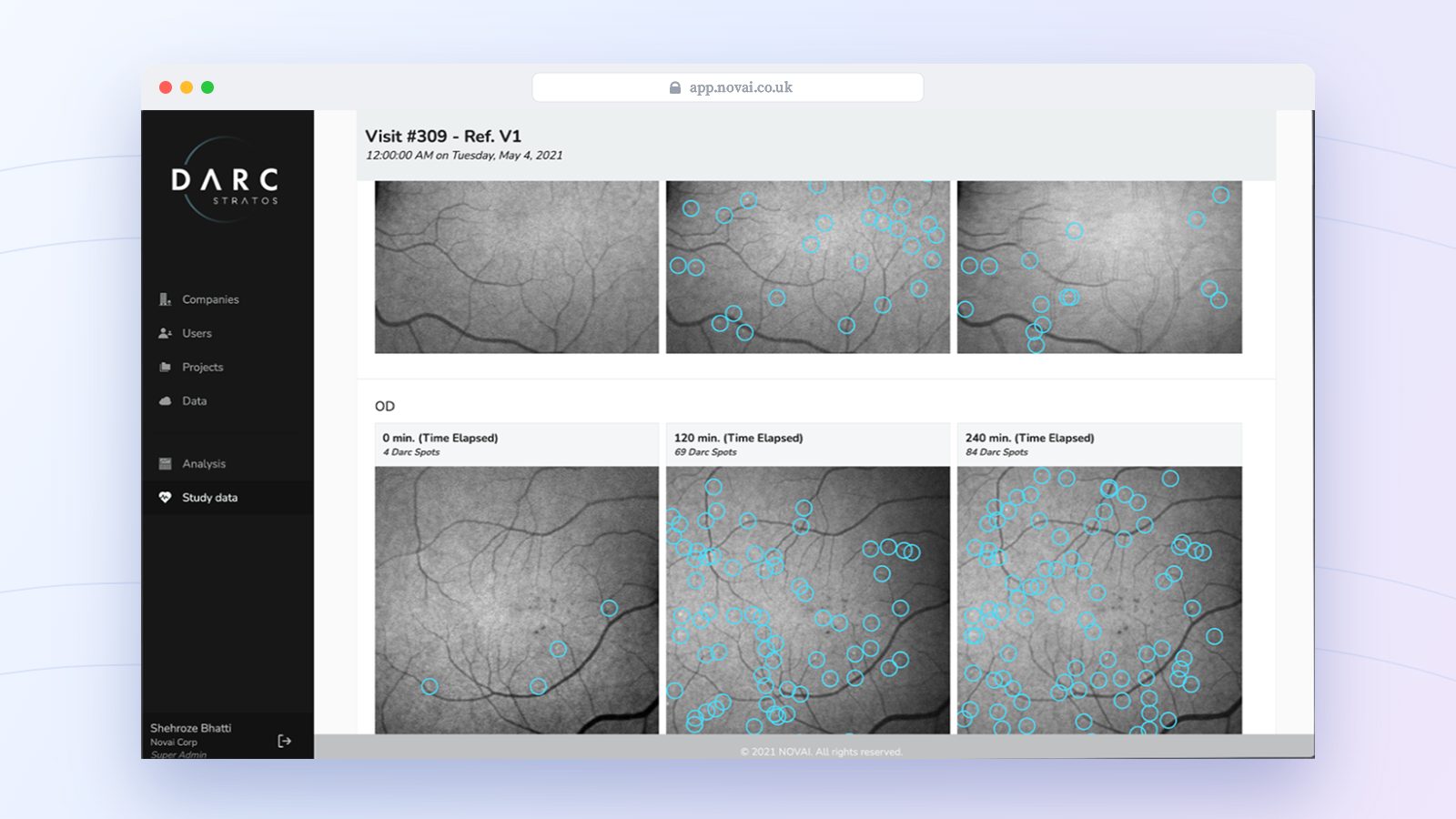
Aegasis Labs designed and built the Darc Stratos platform end-to-end — AI model, cloud architecture, data pipeline, and user interface. The platform is purpose-built for ophthalmic clinical trials: it ingests retinal imaging data from global locations, runs AI-powered analysis using Novai’s DARC algorithm, and delivers real-time results and automated reports to pharmaceutical teams anywhere in the world.
Every architectural decision was shaped by two non-negotiables: the AI had to be accurate enough for pharmaceutical research, and the infrastructure had to be secure and compliant enough to handle sensitive patient data across jurisdictions. Those constraints weren’t treated as limitations to work around — they were the design brief.
The AI Engine
The core of Darc Stratos is a computer vision AI model trained on retinal imaging data to detect and quantify apoptosing retinal cells — the cellular signature that DARC technology makes visible. The model was developed using Python and TensorFlow, trained and deployed via AWS SageMaker, and optimized specifically for the sensitivity requirements of early-stage disease detection.
Achieving greater than 90% accuracy in early-stage glaucoma detection required more than a well-trained model. It required careful dataset curation, iterative model evaluation against clinical standards, and a deployment architecture that maintained consistent inference quality under real-world trial conditions — variable image quality, different imaging equipment across sites, and patient populations with varying disease profiles.
The Cloud Architecture
The platform runs on a fully serverless AWS architecture designed for the specific demands of clinical trial infrastructure: high availability, automatic scaling, and data residency controls that can be configured by geography.
- AI Inference. AWS SageMaker handles AI model training, versioning, and inference at scale — allowing the detection algorithm to run concurrently across multiple active trials without performance impact.
- Pipeline Orchestration. AWS Batch and Step Functions orchestrate the analysis pipeline — receiving imaging data, queuing analysis jobs, running detection, and returning results — automatically, without manual coordination between steps.
- Scalable Compute. Elastic Container Service and Lambda provide the serverless compute layer for the application, scaling automatically with demand and maintaining 100% uptime without fixed infrastructure overhead.
- Data Security. Patient data is encrypted at rest and in transit, with storage configured to meet data residency requirements across different geographies. Access controls are tiered by user role, ensuring that trial coordinators, clinical analysts, and administrators each operate within their appropriate permissions.
What Was Built
- AI Detection Engine: TensorFlow-based computer vision model trained to detect and quantify apoptosing retinal cells from standard imaging equipment — deployed on AWS SageMaker with >90% accuracy in early-stage glaucoma detection.
- Remote Data Capture: Direct data entry from global trial sites into the centralized system, eliminating manual data transfer between locations and the transcription errors that accompany it.
- Automated Cloud Analysis: AWS Batch and Step Functions orchestrate concurrent analysis pipelines across multiple active trials — processing imaging data automatically as it arrives, at any volume, without manual intervention.
- Real-Time Trial Reporting: Live dashboards and automated reports generated directly from collected trial data, updated in real time as new results come in — giving pharmaceutical teams current visibility throughout the trial rather than periodic batch summaries.
- Multi-Geography Data Security: Encrypted storage and transfer with geography-specific data residency controls, tiered role-based access, and audit-ready data handling designed for the compliance requirements of international clinical research.
- Multi-Tier User Interface: An Angular web application with role-differentiated interfaces for trial coordinators, clinicians, analysts, and administrators — each with the appropriate actions, views, and data access for their function in the trial.
- Serverless Scaling Architecture: ECS and Lambda providing auto-scaling compute that expands with trial volume and contracts when demand drops — supporting concurrent trials without fixed infrastructure costs or manual capacity management.
- Containerized Deployment: Docker and Kubernetes for consistent, reproducible application deployment across environments — ensuring that the platform behaves identically in development, staging, and production, and that updates can be shipped without downtime.
Technologies:
- Python and TensorFlow for AI model development and training
- AWS SageMaker for model training, deployment, and inference at scale
- AWS Batch and Step Functions for analysis pipeline orchestration
- AWS Elastic Container Service and Lambda for serverless compute and autoscaling/
- Python Flask for the REST API layer
- Angular for the multi-tier frontend application
- Docker and Kubernetes for containerized, reproducible deployment
- AWS encryption, IAM, and geography-specific storage controls for data security and compliance
The stack was selected for reliability and proven performance in regulated data environments. AWS’s global infrastructure gave the platform the geographic flexibility Novai needed for international trials, while SageMaker’s managed ML infrastructure allowed the AI model to be updated and retrained without disrupting live platform availability.
How We Worked Together
Aegasis Labs‘ Discover, Design, Build, Scale delivery model kept the Darc Stratos engagement on track across a technically demanding scope with a fixed external deadline. Building AI for clinical research doesn’t allow for the kind of iterative exploration that works in consumer or enterprise SaaS. The accuracy and compliance requirements are defined upfront, and the architecture has to support them from the first deployment — not after a round of production learning.
- Discover. We started by working closely with Novai’s scientific and business teams to understand the DARC technology, the clinical trial workflows it would support, the regulatory environment across target geographies, and the accuracy thresholds the AI needed to meet for pharmaceutical acceptance. That discovery shaped the entire technical specification.
- Design. The AI model architecture, cloud infrastructure design, data security model, and multi-tier user experience were designed as a coherent system before development began. Data residency requirements were mapped to specific AWS configurations early — compliance concerns that retrofitted onto an existing architecture are significantly harder to resolve than ones designed in from the start.
- Build. AI model development, cloud infrastructure build, API development, and frontend delivery ran in parallel. SageMaker-based training pipelines allowed the model to be iterated and evaluated against accuracy targets continuously throughout the build, rather than as a final validation step.
- Scale. The serverless architecture was load-tested for concurrent trial scenarios before the first pharmaceutical client went live. Monitoring, alerting, and automated scaling were operational from launch — the 100% uptime commitment wasn’t a target, it was an architectural guarantee.
The Results
Research-Grade AI. Enterprise-Grade Infrastructure. Live Within Timeline.
Darc Stratos launched as a production clinical data trials system, delivered within the Innovate UK grant timeline and deployed with Novai’s first pharmaceutical client. The outcomes it delivered against the four problems the platform was built to solve are specific and sourced directly from the build.
What Darc Stratos Delivered
A production AI clinical trials platform with >90% early-stage glaucoma detection accuracy, 100% uptime on a serverless AWS architecture, encrypted multi-geography data handling, concurrent trial analysis, and real-time reporting — purpose-built for pharmaceutical clinical research.
The results across each dimension of the platform:
- AI accuracy at research grade. The detection engine exceeded the 90% accuracy threshold in early-stage glaucoma identification — the benchmark required for the output to function as a credible clinical biomarker. That accuracy was maintained across variable imaging conditions and patient populations, not just in controlled test datasets.
- 100% system uptime on serverless architecture. The fully serverless AWS deployment delivered the reliability target from day one. Auto-scaling handled demand spikes without degradation. There was no fixed infrastructure to maintain, no scheduled downtime for capacity management, and no single point of failure in the analysis pipeline.
- Global patient data handling with full compliance. The platform encrypted, stored, and managed sensitive patient data across different geographies with data residency controls configured per jurisdiction. Pharmaceutical trial teams in different countries could access the system with role-appropriate permissions while patient data remained governed by the appropriate regional requirements.
- Concurrent trial analysis at scale. Multiple trials could run simultaneously without competition for compute resources. The serverless pipeline architecture scaled automatically with the number of active trials, meaning Novai could onboard new pharmaceutical clients without re-architecting the platform or pre-provisioning capacity.
- Real-time visibility throughout the trial. Pharmaceutical teams had live access to trial data and automated reports as results were generated — not weekly summaries or batch exports. That real-time visibility changed how teams could manage and respond to trial progress, giving them the kind of continuous data access that static reporting workflows don’t support.
- Intuitive multi-tier experience for trial users. The role-differentiated interface gave trial coordinators, clinicians, and administrators precisely the views and actions they needed — without exposing users to complexity outside their function. Data was entered directly into the system from global sites, eliminating the transfer errors and inconsistencies of manual workflows.
The broader significance of the platform is what it enables for Novai’s customers. Clinical trials that previously required two to five years to generate endpoints can now be structured around a biomarker that detects cellular-level disease activity far earlier in the process. For pharmaceutical companies developing neuroprotective treatments for glaucoma and AMD, that compression in timeline translates directly into reduced development cost and risk. Darc Stratos is the infrastructure that makes DARC technology usable at commercial scale — and Aegasis Labs built it to that standard.
Build Your AI Platform with Aegasis Labs
Novai brought us a scientifically validated technology and a hard deadline. What they needed was an engineering partner who understood how to build AI systems to clinical standards — where accuracy thresholds aren’t aspirational targets but defined requirements, and where the infrastructure has to perform correctly from the first deployment.
Aegasis Labs builds AI systems and cloud platforms across regulated and high-stakes domains — from biotechnology and healthcare to financial compliance and enterprise automation. If your organization is ready to move from a validated technology to a production platform, we know how to get you there.
Ready to Build Your AI Platform?
Whether you’re commercializing a research-grade technology or building a cloud-based AI system for a regulated industry, visit aegasislabs.com to start the conversation.
If you’re building an intelligent system that needs to perform accurately in a high-stakes domain, visit aegasislabs.com to start the conversation.