If you’re building a platform that needs to serve both your internal teams and your customers well, get in touch to start the conversation.


Executive Summary
Building an e-commerce platform for a global consumer brand like Nestlé isn’t just a matter of standing up a storefront. It’s about giving a large, cross-functional brand team the ability to manage products, content, and promotions independently, on their own schedule, while customers get a shopping experience that feels seamless rather than assembled from disconnected parts bolted together after the fact.
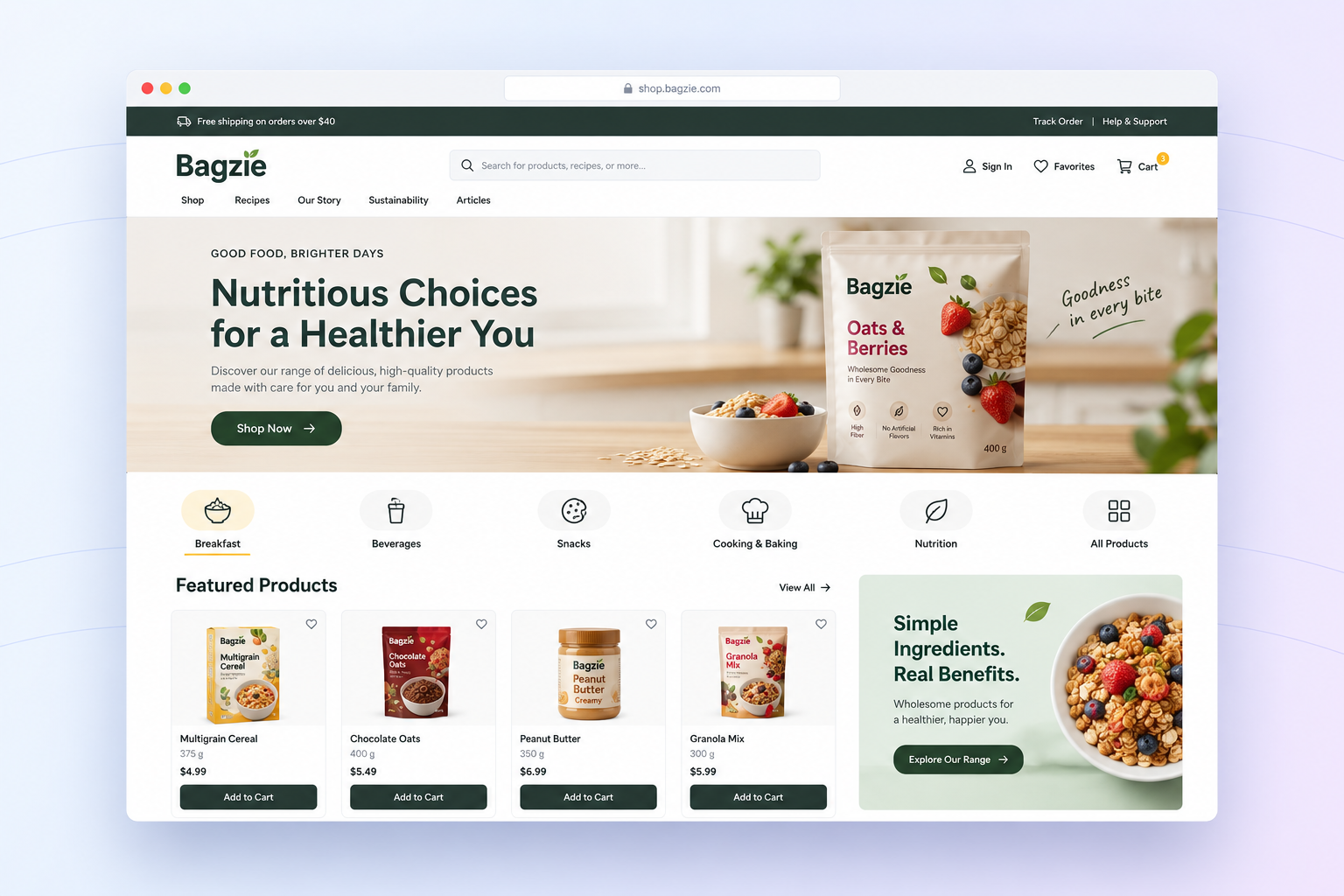
Bagzie was built to do exactly that. Aegasis Labs partnered with another development company to design and build a Django powered platform for one of Nestlé’s brands, combining a flexible content management layer with a full online storefront in a single, unified system. Content and commerce weren’t treated as two separate problems solved by two separate tools. They were built as one.
About Bagzie
Bagzie needed to serve two very different users at once, and serve both of them well. On one side, the brand’s content and marketing teams needed direct control over the product catalog, page publishing, and promotional campaigns, the kind of day to day operational work that shouldn’t require a developer ticket every time a product listing needs updating or a seasonal promotion needs to go live. On the other side, customers needed a shopping experience, browsing, cart, checkout, that felt smooth, fast, and reliable, the way any modern e-commerce platform is expected to behave regardless of what’s happening behind the scenes.
Most e-commerce platforms handle these two needs as separate systems, stitched together through integrations layered on after the initial build. That approach tends to work, in the narrow sense that it produces a functioning site. But for a brand operating at Nestlé’s scale, the seams in that kind of architecture tend to show. Publishing workflows drift out of sync between marketing and engineering. Content updates lag behind what the storefront actually displays. The shopping experience starts to feel structurally disconnected from the content and campaigns built around it. Avoiding that outcome meant designing content and commerce as one system from the start, not reconciling two systems after the fact.
The Challenge
Two systems, one platform, one data model. Content management and e-commerce functionality typically live in entirely separate tools, each with its own data model, its own admin experience, and its own assumptions about how information flows. Building both into a single Django based system meant designing an architecture where product data, page content, and promotional material could all be managed cohesively within one platform, without the commerce side compromising the flexibility of the content side, or vice versa.
Independence for non-technical teams had to be real, not nominal. The brand’s marketing and content teams needed to manage products, pages, and campaigns on their own timeline, without queuing up developer tickets for routine updates that should be self-service. That’s a higher bar than simply having a CMS technically present in the stack. It meant the CMS layer had to be genuinely usable day to day by people whose job is marketing, not engineering, and who need to move at the pace of a campaign calendar rather than a sprint cycle.
Delivering as part of a multi-team engagement raised the coordination difficulty considerably. This wasn’t a single vendor build where one team owns every decision end to end. Aegasis Labs worked alongside a partner development company, which meant aligning architecture decisions, integration points, and delivery timelines across two separate teams working toward one shared set of requirements, with Nestlé’s brand, content, and commerce standards as the bar both teams had to meet together. Without tight coordination, two teams building toward the same platform can easily end up with inconsistent assumptions about how the pieces are supposed to fit.
The Solution
A Unified Django Platform, Built for Both Content and Commerce
The core architectural decision behind Bagzie was to build content management and e-commerce transactions into a single Django based platform from the outset, rather than integrating separate systems after the fact. That choice shaped nearly every downstream decision. Product data, page content, and promotional material all live within the same system, giving the brand’s team one coherent place to manage the storefront instead of switching between disconnected tools with different rules and different data.
CMS Layer
On top of that unified foundation, the CMS layer was designed specifically around how the brand’s own content and marketing teams actually work. They got direct, independent control over products, pages, and promotional content, without routing every routine change through an engineering queue. That independence was the whole point of building the CMS as a first class part of the architecture rather than an add-on. It’s what lets a marketing team run a campaign on its own schedule instead of a development team’s.
E-commerce Functionality
Alongside the CMS, the core shopping experience was built out with the fundamentals a production storefront depends on: product catalog management, cart functionality, and checkout flows engineered to support real transactional volume, not just a demo ready prototype. This needed to function as a genuine production e-commerce experience, not a content site with a shop bolted on, so the underlying commerce logic was built with the same rigor as any standalone storefront platform, just integrated tightly with the content layer around it.
Cross-Team Integration
Because this was a joint delivery, a meaningful part of the engineering work was inherently collaborative. The team worked directly with the partner development company to integrate the platform with the third-party services a production e-commerce system depends on, payment processing among them, along with the other supporting infrastructure any live storefront requires. Both teams coordinated closely to make sure the end result met Nestlé’s requirements as one coherent platform, rather than two separately built halves stitched together at the last stage of delivery.
What Was Built
- Unified CMS and e-commerce architecture
a single Django based system handling both content management and online transactions within one data model and one platform, rather than as separately integrated tools - Independent content management
a CMS layer purpose-built to let the brand’s marketing and content teams manage products, pages, and promotions on their own schedule, without engineering dependency for routine updates - Core shopping functionality:
Product catalog management, cart, and checkout flows engineered for a full production-grade online shopping experience - Third-party service integrations:
Supporting services integrated in close collaboration with the partner development team, meeting the requirements of a live, production e-commerce environment - Cross-team delivery coordination:
Architecture and integration decisions aligned across two development teams to ensure a single, consistent platform outcome for the brand
Technologies Used
- Languages: Python
- Framework: Django (full CMS-based e-commerce platform)
- Architecture: Content management system integrated with e-commerce storefront
The Results
Bagzie launched as a working platform for the Nestlé brand, one system where content management and commerce operate together as a single coherent whole rather than as separate, loosely connected tools stitched together after launch.
- One platform, not a patchwork
content and commerce run on the same system, so there’s no lag between what marketing publishes and what the storefront displays - Independence for the brand team
Marketing and content staff manage products, pages, and campaigns on their own schedule, without waiting on development cycles for routine changes - A consistent customer experience
Shoppers get a storefront built on a single foundation rather than one stitched together from disconnected integrations with visible seams - Proof of clean multi-team delivery
Two development teams, one shared architecture, and one outcome that met Nestlé’s requirements without the seams showing between who built what
For the engagement itself, Bagzie stands as a working example of Aegasis Labs delivering complex, multi-team projects for enterprise-scale brands, coordinating cleanly across teams, architecture decisions, and delivery standards, without losing sight of what the end platform actually needed to do for the people using it on both sides: the brand team managing it, and the customers shopping on it.
Build Your AI Platform with Aegasis Labs
Bagzie was a project defined as much by coordination as by code, building a single, cohesive platform to serve two distinct sets of users, delivered as part of a multi-team engagement for one of the world’s largest consumer brands, where the standard for both technical execution and cross-team alignment was set by Nestlé itself.
That ability to design cleanly, integrate reliably, and deliver well as part of a larger team, without the seams showing, is core to how Aegasis Labs approaches enterprise-scale engagements.
Start a conversation with our team
We’re a certified AWS and Microsoft partner with 70+ projects delivered across 8+ industries — including healthcare, finance, and enterprise technology.
Explore our Enterprise AI Automation services →See our engagement models