If your organization manages large volumes of technical documentation and your teams are losing time searching for answers that should be immediately accessible, visit aegasislabs.com/generative-ai-applications to start the conversation.


Executive Summary
Field engineers do not have time to search. When an installation is underway and a technical question comes up on-site, the answer needs to be fast, precise, and correct. In boiler engineering specifically, incorrect information is not just an operational problem. It carries real safety and compliance consequences for engineers, clients, and the buildings they serve.
Our client is a UK-based boiler engineering company whose field engineers were losing significant time on-site searching through dense, sprawling technical documentation to find the specific guidance they needed for each installation. The documentation existed. The answers were in there. Getting to them quickly and accurately enough for real-world field use was the problem.
Aegasis Labs built a Retrieval-Augmented Generation (RAG) platform that lets engineers query gigabytes of technical documentation in plain language and get fast, accurate, source-grounded answers directly in the field. The platform was engineered to a near zero-hallucination standard from the ground up, because in this domain the cost of a wrong answer is not a minor inconvenience. It is a safety and compliance risk.
The result is a RAG agent that operates at the accuracy level the engineering context demands, at the speed field use requires, accessible through a clean React interface optimized for on-site conditions.
About Company
The organization is a UK-based boiler engineering company with field engineers operating across installation sites where access to accurate technical documentation is not a convenience but a professional necessity. Boiler installation and servicing involves complex technical specifications, model-specific parameters, and compliance requirements that vary across products and contexts. The documentation governing those specifications is comprehensive by design.
That comprehensiveness is both the asset and the challenge. The technical manuals and reference materials that engineers rely on are dense, detailed, and extensive. They cover a wide range of boiler models, installation scenarios, and regulatory requirements. For an engineer on-site with a specific question, the relevant answer could be anywhere across a large and growing documentation corpus.
The organization wanted a technology partner who understood both the AI architecture required to solve that retrieval problem and the domain context that made accuracy non-negotiable. Getting an answer fast is only useful if the answer is right.
The Challenge
The Right Answer Exists Somewhere in the Documentation. Finding It Is the Problem.
Technical documentation for complex engineering products is built for completeness, not for fast field retrieval. A comprehensive installation manual covers every configuration, every variant, every edge case. That thoroughness is exactly what makes it valuable as a reference and exactly what makes it slow to navigate when an engineer needs one specific answer under time pressure.
Boiler installation operates within a strict regulatory and safety framework. Engineers work to specifications that govern everything from flue configurations to pressure settings to commissioning procedures. The guidance for any given scenario needs to come from the correct section of the correct technical manual for the correct boiler model. A response that blends information from multiple sources, applies guidance from one model to another, or generates plausible-sounding but unsupported instructions does not just give a wrong answer. It creates a compliance exposure and a safety risk that the organization cannot accept.
Three problems defined the operational challenge.
Search time was a measurable, compounding cost. Every time an engineer stopped an installation to search for a specification, a compliance reference, or a configuration detail, that search consumed time that should have been going into the work itself. Across a full workforce and a full week, the cumulative cost of that search time was significant. The engineers were not slow or unskilled. The process of locating precise information inside large technical documentation sets is inherently inefficient without the right tooling.
Standard keyword search was not the right tool for the retrieval problem. A keyword search across gigabytes of technical documentation either returns too many results to be useful or misses the relevant passage because the engineer’s natural language query does not match the exact terminology used in the manual. What engineers needed was semantic retrieval: a system that understands what they are asking, not just what words they used, and returns the passage that answers their specific question rather than a list of documents that might contain it.
Accuracy was a hard constraint, not a quality preference. The engineering domain carries safety and compliance implications where incorrect technical information has real consequences. A system that generates confident-sounding but wrong answers to queries about pressure ratings, installation requirements, or compliance specifications is not a productivity tool. It is a liability. Any AI system deployed to engineers in the field had to be engineered with hallucination prevention as a primary design requirement, treated with the same seriousness as any other safety-critical specification.
The combination of these three problems meant that a generic AI assistant or a standard search improvement would not solve what the client actually needed. The solution had to be purpose-built for the domain, the documentation, and the accuracy standard required.
The Solution
A RAG Platform Built for Engineering Teams
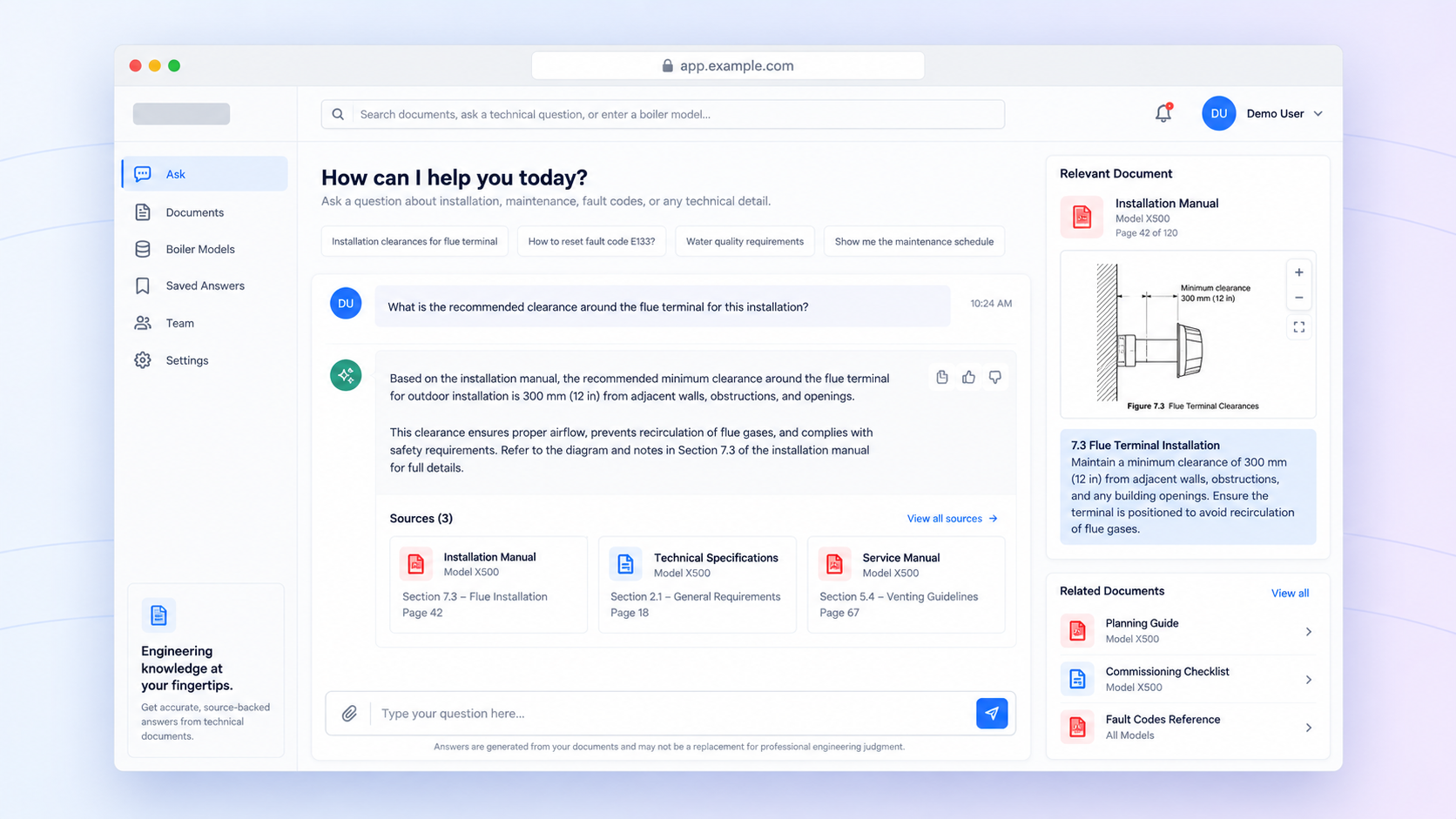
Aegasis Labs designed and built a purpose-built RAG agent for this engineering company’s field workforce. The architecture, the retrieval approach, the accuracy engineering, and the interface were all shaped by one governing requirement: give engineers fast, accurate, source-grounded answers to technical queries, at near zero-hallucination standard, in the conditions where they actually work.
Retrieval-Augmented Generation was the right architecture for this use case for a specific reason. A RAG system does not rely on an LLM’s general training to generate answers from memory. It retrieves the relevant passages from the actual source documentation first, then generates a response grounded in what it found. The model cannot invent an answer the documentation does not support, because the documentation is the basis for everything it generates. That architectural grounding is what makes near zero-hallucination achievable as an engineering target rather than an aspiration.
The Document Ingestion Pipeline
The foundation of the RAG agent is the ingestion pipeline that processes and structures the client’s full technical documentation library. Gigabytes of installation manuals, configuration guides, compliance references, pressure specifications, and maintenance documentation were ingested, parsed, chunked into semantically meaningful segments, and embedded into a vector store for retrieval.
The pipeline was built to scale as the documentation library grows. New product lines, updated manuals, and additional reference material can be added without rebuilding the system. The retrieval index stays current as the product range and regulatory landscape evolve.
The Retrieval Engine
When an engineer submits a query, the retrieval layer searches the vector store semantically rather than by keyword match. The system identifies the passages most relevant to the specific question being asked, accounting for the product context and installation scenario where that information is available, and returns them as the grounded basis for the response.
This surfaces the right passage rather than the right document. An engineer asking about a specific configuration or compliance requirement gets the section that answers that question directly, not a pointer to a manual they then have to navigate themselves.
Hallucination Mitigation and Accuracy Engineering
The near zero-hallucination requirement was treated as a primary engineering constraint throughout the build. The system applies grounding and validation techniques that ensure responses are consistently traceable back to source documentation. Source references are attached to every answer, giving engineers a clear signal of where the information came from and the ability to verify the underlying passage when additional confidence is needed.
The LLM’s role in the system is deliberately constrained. It synthesizes and presents retrieved content clearly. It does not reason beyond what the documentation supports. When a query does not have a clear answer in the documentation, the system surfaces that limitation rather than generating a response that could be wrong. In a safety-critical domain, knowing the system’s limits is as important as knowing its capabilities.
The Field Engineer Interface
The React-based interface was built around the conditions where engineers actually use it: on-site, during active installations, often on a mobile device, under time pressure. The design is intentionally simple. A query input, a response, and a source reference. The interaction is fast enough to fit naturally into the rhythm of installation work rather than interrupting it.
Speed and simplicity were design requirements that shaped every interface decision. A tool that works well in a controlled office environment but is too slow or too complex to use on a job site has not solved the problem.
The interface was optimized for mobile and on-site use, recognizing that the platform’s value depends entirely on it being usable in the environment where engineers actually work, not just in an office with a desktop browser.
Technologies Used
-
Python for the backend and RAG pipeline,
-
JavaScript and React for the frontend
-
vector search for semantic retrieval
- Retrieval-Augmented Generation (RAG)
-
Zero-hallucination accuracy engineering
-
large-scale technical document retrieval
- LLM-based question answering
How We Worked Together
Aegasis Labs’ Discover, Design, Build, Scale delivery model kept the engagement structured across a technically demanding scope. Safety-critical AI systems require more architectural precision upfront than most AI projects. The hallucination mitigation approach, the document chunking and indexing strategy, and the retrieval accuracy targets were all defined and validated before the system reached engineers in the field.
We started by working with the client to understand the documentation landscape in detail: the volume and variety of manuals, how engineers actually asked questions during installations, what kinds of queries came up most frequently, and what the consequences of a wrong answer looked like in practice. That understanding shaped every subsequent decision.
The ingestion pipeline and retrieval layer were designed and validated before the frontend was built. Retrieval accuracy is the foundation everything else depends on. A fast, well-designed interface that surfaces imprecise answers does not solve the problem. Getting the retrieval right was the prerequisite.
The interface was developed in close alignment with how engineers actually work on-site, prioritizing the interaction patterns that fit real installation workflows rather than generic UX conventions.
Accuracy validation ran throughout the build as a continuous process rather than a final quality gate. Retrieval precision and response grounding were tested against real documentation queries at each stage, allowing the system to be tuned before it reached production.
The Results
The RAG agent is live and in use by field engineers during active installations. The outcomes map directly to the three problems the engagement was built to solve.
Search time during installations is reduced. Engineers submit a natural language query and receive a specific, source-grounded answer in the time it would previously have taken to locate the right manual and find the relevant section. The agent does not replace engineer judgment. It removes the mechanical retrieval work that was consuming time that judgment should be applied to.
The near zero-hallucination standard holds in production. Responses are grounded in source documentation, with references attached to every answer. The system surfaces its own limitations when the documentation does not clearly support a response, which is more reliable behavior than returning a confident-sounding wrong answer.
The documentation index scales without re-architecture. New product lines and updated manuals are added through the ingestion pipeline as they become available. Engineers working with newer models have access to the same retrieval quality as engineers working with established ones.
The interface performs in real field conditions. Speed and simplicity were design requirements from the start, not features optimized after launch. Engineers use the platform on-site, under time pressure, in the conditions where technical answers are actually needed.
The broader outcome is a structural change in how technical knowledge reaches the engineering workforce. Documentation that previously required significant time and navigation to search is now queryable in plain language, with answers that are fast, accurate, and traceable back to source. That shift gives engineers more time doing the skilled work they are hired to do and less time searching for information that should be immediately available.
Build Your AI Knowledge Platform with Aegasis Labs
This client needed more than a search improvement. They needed an AI system engineered to the specific accuracy standard their domain required, built on a retrieval architecture that grounded every answer in real documentation, and fast enough to be genuinely useful during active field work.
That precision is what Aegasis Labs brings to every Generative AI engagement. We build RAG systems, knowledge platforms, and domain-specific AI applications that meet the accuracy requirements of the environments they serve — not just the environments where AI looks impressive in a demo.
Start a conversation with our team
We’re a certified AWS and Microsoft partner with 70+ projects delivered across 8+ industries — including healthcare, finance, and enterprise technology.
Explore our Enterprise AI Automation services →See our engagement models