
Executive Summary
Growth creates a specific kind of problem for service agencies. The work gets more complex, the client list gets longer, and the sales operation that got you here — built on manual processes, spreadsheet reports, and individual follow-up habits — starts to buckle under the weight of what you’re trying to become.
That was the situation with one of our clients. A results-driven digital marketing agency with a strong delivery track record and a sales workflow that was running on human effort, context-switching, and institutional knowledge. It worked, until scale made it a liability.
Aegasis Labs partnered with them to replace their manual sales operations with an AI-driven automation system — without disrupting the team or the tools already in place. We mapped their end-to-end sales workflow, identified every process that could be systematized, and built a modular automation layer that handled lead qualification, multi-channel follow-ups, CRM synchronization, and real-time reporting. The result: 80% of repetitive sales tasks automated, faster response times, higher data accuracy, and a pipeline the leadership team could actually see in real time.
About the Agency
Our client is a results-driven digital marketing agency that serves businesses across a range of industries, helping them improve sales performance and marketing efficiency. They have a strong delivery track record — the kind built through consistent client outcomes rather than marketing spend.
The sales team developed their own follow-up habits. Reporting happened through a combination of CRM exports and manual spreadsheet work. Lead qualification depended on individual judgment rather than a consistent scoring framework. None of this was unusual. All of it was a problem at scale. As the agency’s client base and lead volume grew, the gap between their delivery capability and their sales infrastructure became harder to ignore.
They needed a partner who understood both automation and the specific operational realities of a fast-moving agency environment. The brief to Aegasis Labs was clear: automate the routine work, keep humans in control of the high-value decisions, and build something the team could actually manage without engineering support.
The Challenge
A Sales Operation That Couldn’t Keep Up With the Business
The core problem wasn’t that the sales team was performing poorly. It was that the system they were operating inside was designed for a smaller, slower business. As volume increased, the inefficiencies compounded. Three patterns defined where things were breaking down.
- Lead qualification was slow and inconsistent. New leads entered the pipeline and sat there while a rep found time to evaluate them. There was no standard scoring logic, no automatic routing, and no way to ensure the right leads reached the right people quickly. In a fast-response environment — where agency clients expect rapid acknowledgment — that delay had a real cost.
- Follow-ups depended entirely on individual rep discipline. Some leads got nurtured attentively. Others went quiet. The inconsistency wasn’t a performance issue; it was a systems issue. There was no mechanism to ensure every prospect moved through a structured cadence regardless of how busy the team was or which rep owned the relationship.
- Reporting was manual, slow, and backward-looking. Compiling weekly and monthly performance summaries required significant time from people who should have been focused on clients. By the time leadership had a clear view of pipeline health, the data was already stale. Bottlenecks got spotted late. Decisions got made on incomplete information.
Underneath these three problems was a structural one: the sales workflow lived across too many disconnected tools. CRM, inbox, spreadsheets, Slack, scheduling software — reps constantly context-switched between them to complete tasks that should have been connected. Every handoff between tools was a chance for something to slip.
The Operational Gap
The agency had the delivery capability to serve a much larger client base. What they lacked was a sales infrastructure that could scale with it — without requiring more headcount to run.
Solving this required more than plugging in an automation tool. It required mapping the actual workflow, understanding where human judgment added value and where it was being wasted on repetitive tasks, and building a system that improved the process without changing how the team fundamentally operated.
The Solution
From Manual to Automated: The Workflow Transformation
Before a single automation was built, Aegasis Labs spent significant time doing something most technology engagements skip: understanding the process completely. Not at a surface level — at the level of every step, every handoff, every tool in the chain, and every point where human attention was being consumed by something that didn’t require it.
Reading the Diagram
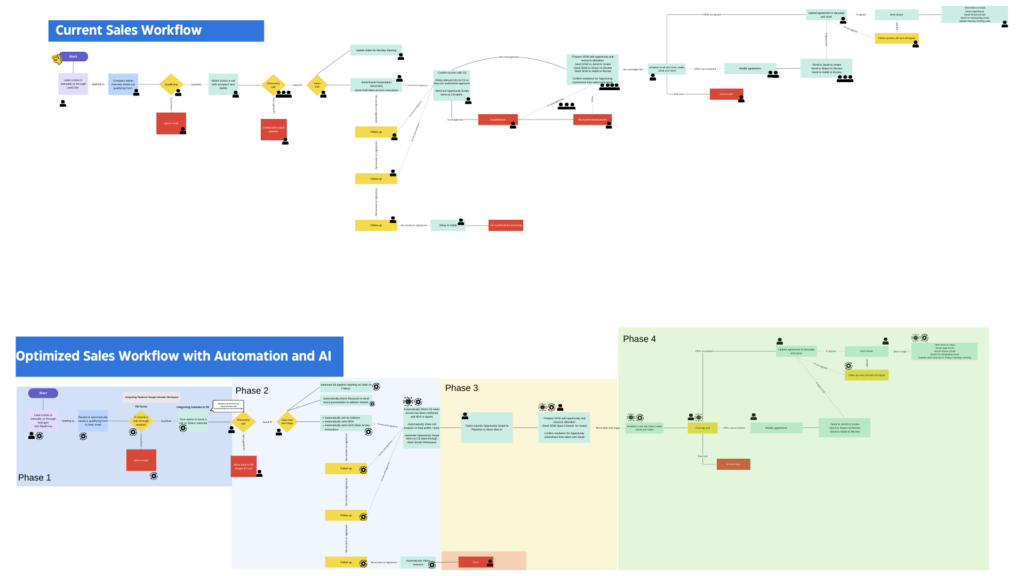
The top section maps the current state: a largely manual, multi-person process where leads enter through qualifying calls, move through discovery and admin steps, receive proposal presentations, and cycle through multiple follow-up loops before reaching a decision. Red nodes indicate dead-end exits — lost leads, removed from pipeline, or no-contact outcomes. Every step requires a rep’s active attention. The process is sequential, and delays compound.
The bottom section shows the optimized workflow, organized into four automation phases. The ⚙️ icons mark where human touchpoints have been replaced or supported by automated logic. The transformation isn’t just cosmetic — the architecture of how work moves through the pipeline is fundamentally different.
Step 1 — Process Mapping
We started by mapping the agency’s complete sales workflow end-to-end. Every stage was documented: how leads came in, who qualified them, how discovery calls were scheduled, what happened after a proposal was sent, how follow-ups were tracked, and how reporting was assembled. We sat with the team, traced the actual path a lead took through the pipeline, and built the current-state workflow map you see in the diagram above.
This wasn’t a theoretical exercise. The current-state map revealed the real shape of the problem — the manual touchpoints, the tool-switching, the stages where deals stalled because a rep hadn’t found time to act, and the reporting cycles that consumed hours every week. It also revealed which parts of the process were genuinely judgment-dependent and needed to stay with the team
Step 2 — Identifying Automation Opportunities
With the workflow mapped, we systematically identified every step that followed a repeatable logic — qualification criteria that could be codified, outreach sequences that could be timed and triggered, data entry tasks that could be handled automatically, notifications that didn’t need a human to send them. Each opportunity was assessed for impact, feasibility, and the risk of removing human involvement from that specific step.
The output wasn’t just a list of things to automate. It was a prioritized view of where AI-driven automation would create the most leverage — reducing the most overhead while preserving the human judgment that genuinely moved deals forward. Sensitive stages like final offer delivery and deal stage changes were flagged for human-in-the-loop controls rather than full automation.
Step 3 — Presenting to the Team
Before building anything, we presented the findings and the proposed automation architecture back to the agency’s leadership and sales team. The presentation covered what we’d found in the process mapping, where the automation opportunities were, what the optimized workflow would look like phase by phase, and what the team would need to manage and adjust after handoff.
That conversation mattered. It gave the team visibility into what was being changed and why, surfaced practical concerns that shaped the final design, and created buy-in before the build began. The optimized workflow diagram — with its four automation phases — was refined through that session. It became the shared blueprint everyone worked from.
Step 4 — Building Phase by Phase
With the process map validated and the automation architecture agreed, we built the system in phases — exactly as labelled in the diagram. Each phase addressed a distinct stage of the sales workflow and could be tested independently before the next one was added. This kept the build manageable, allowed the team to adapt as each phase went live, and meant that problems in one phase didn’t block progress on others.
The four phases — lead capture and pipeline sync, discovery and automated outreach, proposal and qualification handoff, and closing and contract management — are documented in the workflow transformation section above. What follows is what was engineered to make each phase work.
How It Works
The platform follows a straightforward flow that mirrors how compliance teams already think about their work — but removes the manual steps that slow everything down.
- Capture & Qualify. A new lead enters the system. Predefined qualification criteria are applied automatically: the lead is evaluated, enriched with additional data, scored by priority, and routed to the right owner — without anyone touching a spreadsheet.
- Nurture & Respond. An automated multi-channel sequence begins. Time-boxed emails and SMS messages go out according to the lead’s status and behavior. When a prospect replies or shows intent signals, the sequence pauses and the lead is handed off to a rep with full context already in the CRM.
- Sync & Track. All activity — calls, emails, status changes, notes — syncs automatically across systems. The CRM stays current without manual data entry. Reps open their dashboard and the state of their pipeline is accurate.
- Report & Decide. Leadership sees pipeline health, conversion rates, SLA adherence, and won/lost trends in real time via auto-generated dashboards. Weekly and monthly summaries are delivered to stakeholders automatically. No spreadsheet required.
An AI System Built for Automation
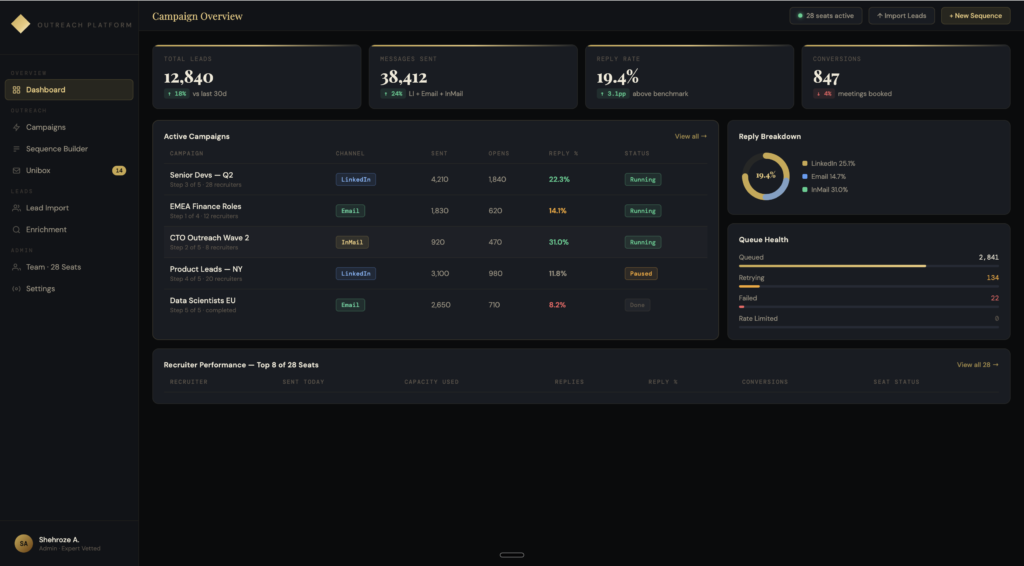
Aegasis Labs designed and built an AI System with these components and modules:
- Lead Qualification & Scoring: Automated evaluation of new leads against predefined criteria, with data enrichment, priority scoring, and routing to the right rep — triggered the moment a lead enters the pipeline.
- Multi-Channel Follow-Up Sequences: Time-boxed email and SMS cadences that run automatically per lead status, pause when a prospect responds, and hand off to a rep when genuine interest is detected.
- CRM Integration & Sync: Bidirectional sync between automated workflows and the existing CRM, keeping activities, notes, and deal stages current across every tool without manual data entry.
- Real-Time Dashboards & Reporting: Custom dashboards delivering live pipeline health, conversion rates, SLA adherence, and won/lost trends. Weekly and monthly summaries auto-delivered to stakeholders.
- Human-in-the-Loop Controls: Guardrails that require rep approval for sensitive workflow steps — changing deal stage, sending final offers — keeping humans in control where judgment matters most.
- Error Handling & Resilience: Structured error detection and recovery built into every workflow, with Slack alerts for failures and automatic retry logic to keep operations running under high volume.
- Audit Logs & Traceability: Every automation step logged with timestamp, payload, and outcome — giving leadership a complete, traceable record of every action taken across the sales pipeline.
- No-Code Configuration Layer: Qualification thresholds, SLA windows, ownership rules, and message templates stored in structured config, adjustable by the ops team without engineering involvement.
Technologies The platform was built on a modern, production-grade stack selected for reliability at scale:
- Zapier and Make.com for workflow automation and inter-tool orchestration
- Python and Google Cloud Functions for data enrichment, lead scoring logic, and message templating
- HubSpot API for CRM integration and pipeline sync
- Airtable and Google Sheets for structured configuration and reporting data
- Slack API for real-time alerts and error notifications
Every workflow component was built modularloogle Cy from the start. Individual automations can be switched on or off, reconfigured, or extended without affecting other flows. The ops team can adjust qualification thresholds, update message sequences, and change routing rules through structured configuration — no developer required after handoff.
How We Worked Together
The engagement followed Aegasis Labs’ four-stage delivery model — Discover, Design, Build, Scale — with the Discover phase doing the heaviest lifting. Automation built on a poorly understood process just makes the wrong things happen faster. Getting the workflow map right first was what made everything downstream reliable.
- Discover. We mapped the agency’s complete sales workflow before touching any tooling — every step, every handoff, every tool in the chain. The flowchart that now lives in their documentation is a direct output of that discovery. It became the blueprint for what to automate and what to leave with the team.
- Design. We designed the automation architecture around the existing stack — HubSpot, Google tools, Slack — rather than asking the team to change how they worked. The goal was a system that felt like an upgrade to their current workflow, not a replacement of it.
- Build. We built and integrated modular automations in parallel: qualification and routing, follow-up sequences, CRM sync, dashboards, and error handling. Python helpers for enrichment and templating were containerized and called from Zapier and Make.com.
- Scale. Before handoff, we ran scenario tests across high-volume days, API rate limits, and common failure modes. We trained the team with playbooks and walkthroughs so non-technical users could manage and adjust workflows independently from day one.
The Results
Faster, Leaner, and Ready to Scale
The automation system went live across the agency’s sales operation and delivered measurable change across every part of the workflow it touched. What previously required continuous human attention now runs reliably in the background — consistent, fast, and visible in real time.
What Changed After Launch 80% of repetitive sales tasks removed from the team’s daily workload — with faster lead response, consistent follow-ups, accurate CRM data, and real-time pipeline visibility replacing the manual processes that had been slowing growth.
In practice, the outcomes broke down across four areas:
- Speed. New leads are qualified, scored, and routed the moment they enter the system. There’s no queue, no delay while a rep finds time to evaluate, and no risk of a high-priority lead sitting idle. Response times improved materially across the board.
- Consistency. Every lead moves through the same follow-up cadence regardless of which rep owns it or how busy the team is. Prospects get nurtured. Responses trigger smart pauses and rep handoffs. The pipeline moves forward reliably rather than depending on individual discipline.
- Accuracy. Automated data capture eliminated the missed fields, duplicate records, and manual entry errors that had created noise in the CRM. Leadership now makes decisions on pipeline data they can trust rather than data they have to verify first.
- Visibility. Real-time dashboards replaced ad-hoc spreadsheet reports. Leadership sees conversion rates, SLA adherence, and won/lost trends as they happen — not a week later. Bottlenecks surface in time to act on them.
The broader shift is one of capacity. The agency’s sales team was spending significant time each week on qualification, follow-up management, and reporting work. That time is now directed toward the work that actually requires them: strategy, client relationships, and closing. The automation didn’t replace the team — it gave them their capacity back.
More leads, more campaigns, and more concurrent client relationships can now be managed without adding headcount to absorb the administrative overhead. That’s the scalability the business needed, built into the infrastructure rather than hired for.
Automate Your Sales Operations with Aegasis Labs
This agency came to us with a clear operational constraint: a growing business and a sales workflow that couldn’t keep up with it. The solution wasn’t a new CRM or a bigger team. It was a smarter system built around the processes and tools they already had. That’s what
Aegasis Labs‘ Enterprise AI Automation service is designed to do. We map your workflows, identify where AI-driven automation creates the most leverage, and build systems that reduce manual overhead, improve consistency, and give leadership the visibility they need to make good decisions fast.
Ready to Scale Your Operations? If manual workflows are limiting your team’s capacity or your business’s ability to grow, visit aegasislabs.com to start the conversation about what automation could look like for your operation.