

Executive Summary
Groundwater scientists and environmental modeling professionals work with some of the most technically dense documentation in any scientific discipline. Simulation codes written in Fortran and Python, hundreds of technical manuals, research papers spanning decades of field study, and modeling reference materials that no single researcher could hold in their head at once. Finding a specific answer inside that body of knowledge, manually, across fragmented and unstructured sources, can consume hours of a working day before any actual scientific analysis begins.
Our client, a groundwater and environmental science organization, needed a better way. They came to Aegasis Labs to build an AI-powered knowledge platform that would let their scientists and researchers query that entire documentation landscape in plain language and get precise, citation-backed answers in seconds.
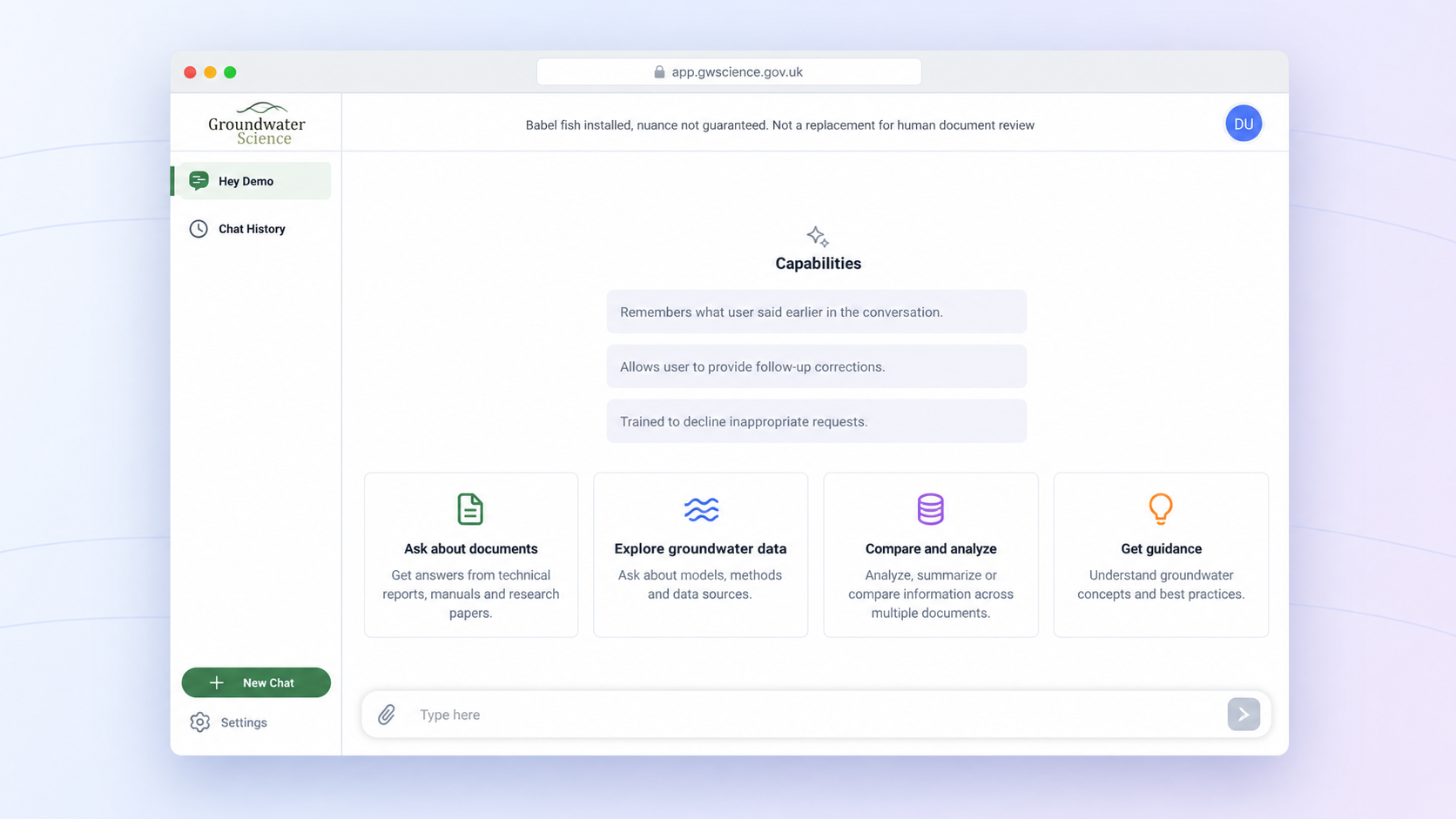
We built the Model Grimoire: a cloud-native, RAG-powered intelligent research platform combining semantic search, natural language understanding, and contextual retrieval into a unified interface. Scientists can now ask technical questions across modeling codes, manuals, and research papers simultaneously and receive accurate, traceable responses linked directly to their original sources. The result is a research environment where deep technical knowledge is instantly accessible, and the hours previously spent searching are redirected to the scientific work that actually matters.
About the Client
The organization operates in the groundwater and environmental modeling space, a discipline defined by technical complexity, regulatory accountability, and the kind of documentation depth that accumulates over decades of scientific practice. Their professionals work daily with modeling codes including Fortran and Python simulation tools, technical manuals governing how those models are applied, and a growing body of research literature that informs both field practice and regulatory compliance.
The knowledge problem they faced was not unusual for organizations of their depth and scale. It was a consequence of doing serious, rigorous work over a long period of time. The more expertise accumulated, the more documentation there was. The more documentation there was, the harder it became to locate precisely the right piece of it when a project needed it.
Technical decisions in environmental modeling need to be traceable. Regulatory submissions need to cite sources. New team members joining a project need to get up to speed without pulling senior researchers away from their own work for hours at a time. All of those needs pointed toward the same solution: a knowledge agent that understood the domain, retrieved with precision, and made every answer traceable back to source.
They needed a purpose-built solution and a technical partner with the AI and cloud expertise to build it properly. That’s where Aegasis Labs came in.
The Challenge
A Documentation Library That Grew Faster Than the Tools to Navigate It
Environmental modeling professionals face a documentation problem that is specific to the complexity of their domain.
The knowledge base they work with is not just large. It is structurally diverse. Simulation codes written in Fortran and Python have their own documentation conventions. Technical manuals describe methodology in formal scientific language. Research papers present findings with their own citation structures and terminology. Each of these source types requires a different reading strategy, and none of them are designed to be queried together.
When a groundwater scientist needs to verify how a particular simulation parameter behaves under a specific set of conditions, or cross-reference a modeling approach against published research, they are often navigating multiple documents, multiple formats, and multiple search interfaces simultaneously. That process is slow by design, because it was never designed at all. It simply accumulated as the knowledge base grew.
There was also a traceability requirement that made the problem harder to solve than it might appear. In scientific and regulatory contexts, an answer is only as useful as its source. A system that produced fast but unattributed responses would not meet the standards of professional practice in this domain. Every response had to link back to the original document, at the claim level, so researchers could verify, cite, and build on what the platform surfaced.
Keyword search fails in this environment in a predictable way. It finds words. It does not find meaning. A researcher asking about hydraulic conductivity calibration for a specific model type does not want every document that contains those words. They want the relevant passage, in context, with enough surrounding information to know whether it applies to their exact situation. Standard search tools cannot make that distinction.
The Core Requirement
Build an AI knowledge system that understands technical groundwater modeling queries in context, retrieves the right passages from across a large, mixed-format document library, and links every answer back to the exact source — so scientists can trust the output and cite it directly.
The technical requirements were demanding. The system needed to work across document types that most search tools handle poorly: code files, scanned manuals, structured reports. It needed to understand domain terminology, preserve context across multi-turn conversations, and return confidence signals so users could judge when to accept an answer and when to dig deeper. All of it needed to run securely on scalable cloud infrastructure.
The Solution
The Model Grimoire: A RAG-Powered Knowledge Companion for Environmental Scientists
Aegasis Labs designed and built The Model Grimoire as a cloud-native, AI-powered knowledge agent tailored specifically to the needs of environmental modeling professionals. The platform is built on Retrieval-Augmented Generation: before the AI writes a single word of response, it retrieves the relevant passages from the document library and grounds its answer in what it found. Nothing is generated from model memory alone. Every response is backed by source material, and every source is cited.
Retrieval-Augmented Generation was the architectural choice that made the accuracy and traceability requirements achievable. Before the AI generates any response, it retrieves the relevant passages from the actual source documentation. The model generates its answer from what it finds, not from general training. That grounding is what makes every response traceable and what keeps the system honest about the limits of what the documentation supports.
How It Works
- Ingest. Documents are ingested, cleaned, chunked into meaningful segments, and embedded into a vector store. Metadata — document type, source, version, section — is preserved throughout and stored in PostgreSQL for traceability.
- Ask. A scientist asks a question in plain language through the chat interface — using natural domain terminology, follow-up context, or a specific technical parameter.
- Retrieve. The hybrid retrieval pipeline queries both the vector store (semantic search via FAISS/Pinecone) and keyword filters simultaneously, surfacing the passages most relevant to the query’s meaning and terminology.
- Answer. The LLM drafts an answer using only the retrieved context — no hallucination from general training data — and attaches citations linking directly to the source document, section, and page.
- Verify. A confidence score based on retrieval quality, source agreement, and content freshness is attached to every response, giving the scientist a clear signal of when to accept the answer and when to open the source directly.
- Improve. Usage patterns, query gaps, and low-confidence triggers feed back into evaluation dashboards, guiding ongoing content curation and retrieval refinement.
What Was Built
-
Knowledge Ingestion Pipeline: Automated ingestion of modeling codes (Fortran/Python), technical manuals, calibration reports, and research papers — with parsing, metadata tagging, chunking, and versioning across mixed file formats.
-
Hybrid Semantic + Keyword Retrieval: A retrieval layer that blends dense vector search (FAISS/Pinecone) with keyword filtering, so queries return results that match both the meaning behind the question and the specific terms used.
-
RAG Chat Interface with Citations: A conversational assistant that answers technical questions in plain language, with every response linked to the exact passage, section, and document it came from — ready for audit trails and regulatory use.
-
Context-Aware Multi-Turn Conversations: Session memory preserves the current modeling context — site, model type, parameters under discussion — so follow-up questions build on prior exchanges without requiring the scientist to repeat background.
-
Confidence Scoring: Every answer carries a confidence score derived from retrieval quality, source agreement, and content recency — giving users a clear, data-backed signal of how much weight to place on each response.
-
Source Management & Access Controls: Admin tooling for document collection management, role-based access scoped by project and sensitivity level, and document lifecycle controls — keeping the knowledge base current and governed.
-
Scalable AWS Cloud Architecture: Containerized microservices on AWS with autoscaling for heavy analytical workloads, background job processing for embedding generation and re-indexing, and structured logging for operational health.
Technologies
- OpenAI LLMs for natural language generation, grounded entirely in retrieved context
- LangChain for RAG orchestration, tool routing, and multi-turn conversation management
- FAISS and Pinecone for vector search and semantic retrieval
- Python (FastAPI/Flask) for backend APIs and pipeline orchestration
- Angular for the responsive web frontend and chat interface
- PostgreSQL for structured metadata storage and audit trails
- AWS (containerized deployment, autoscaling, secure networking) with Docker
- Mixpanel for product analytics, Sentry for error tracking and observability
The architecture was designed for longevity. The vector store is pluggable — switching between FAISS and Pinecone requires no application-layer changes. New document collections, additional model corpora, or expanded retrieval strategies can be added incrementally as the library grows, without re-architecting the core system.
How We Worked Together
Aegasis Labs followed a Discover, Design, Build, Scale delivery model that kept the engagement structured across a technically complex scope. Building a RAG system for a specialist scientific domain requires more upfront precision than most AI projects. The retrieval accuracy depends entirely on how the ingestion pipeline, chunking strategy, and metadata schema are designed before any queries run.
- Discover. We started by mapping Ground Water Science’s complete document landscape: what types of files existed, how they were structured, what kinds of queries scientists actually asked, and what ‘a good answer’ looked like in each case. That discovery shaped every downstream decision.
- Design. We designed the ingestion pipeline, chunking strategy, metadata schema, and hybrid retrieval architecture before writing application code. Getting the document representation right is what determines whether the system returns useful answers or plausible-sounding ones.
- Build. We built the full stack in parallel: ingestion pipeline, vector store setup, RAG orchestration layer, backend APIs, Angular frontend, and AWS cloud infrastructure. Confidence scoring and observability tooling were built in from the start, not added afterward.
- Scale. Usage analytics and quality feedback loops were live at launch. Mixpanel dashboards surface documentation gaps and low-confidence query patterns — giving Ground Water Science a continuous improvement signal rather than a static system that degrades as the document library evolves.
The Results
Trusted Answers. Traceable Sources. Time Given Back to Science.
The Model Grimoire launched as a production knowledge platform used by Ground Water Science’s scientists and analysts in their day-to-day modeling work. The outcomes it delivered address the specific problems the platform was built to solve.
What The Model Grimoire Delivers
Precise, citation-backed answers to technical groundwater modeling queries — retrieved from a mixed-format document library in seconds, with confidence signals, context memory, and an audit trail on every response.
The results break down across four dimensions that matter most to a scientific consulting environment:
- Speed and precision. Search time for common technical questions dropped from hours to minutes. The hybrid retrieval layer surfaces the right passage from the right document — not a list of documents that might contain the answer. Scientists get what they need and get back to their work.
- Auditability and trust. Every response links to the exact source passage, section, and document. For regulatory submissions, internal review, and decision documentation, that traceability isn’t a nice-to-have — it’s a requirement. The platform delivers it automatically on every query.
- Better decisions during complex modeling. The context-aware conversation preserves the current modeling scenario across follow-up questions, surfaces related parameters and assumptions, and highlights conflicting references when they exist across different sources. That’s a qualitatively different level of support than a document search can provide.
- Faster onboarding for new analysts. New team members can ask natural-language questions about modeling workflows, boundary conditions, calibration steps, and code behavior — and get source-linked answers immediately. The mentor time that would have gone into answering those questions repeatedly stays with the work that actually requires it.
The observability layer adds a dimension that most knowledge systems lack: a continuous improvement signal. Mixpanel dashboards show which queries are triggering low confidence scores, where documentation gaps exist, and which model topics are most frequently searched. Ground Water Science can act on that data to improve content coverage over time, rather than treating the platform as a static deployment.
The scalable AWS architecture means the system grows with the document library and the team. New modeling codes, additional research corpora, and expanded use across projects can be added without re-architecting the foundation. The Model Grimoire is built to get more useful over time — not plateau at launch.
Build Your AI Product with Aegasis Labs
Ground Water Science had a documentation problem that was costing their team hours every week and adding friction to every project. The solution wasn’t better search. It was a purpose-built AI system that understood their domain, retrieved with precision, and made every answer traceable.
That’s what Aegasis Labs designs and builds across every Generative AI engagement — systems that behave correctly under the specific demands of the domain they serve. From RAG architecture and LLM orchestration to cloud deployment and observability, we take knowledge-intensive AI products from concept to production.
Turn Your Technical Documentation Into a Trusted Knowledge Asset
If your team is losing hours to information retrieval — or your decisions need to be more traceable and consistent — visit aegasislabs.com/generative-ai-applications to see how a purpose-built RAG system could change that.