Bagzie E-commerce Platform for a Nestlé Brand


Executive Summary
Appraisal work is built on evidence. Every figure in a commercial real estate valuation report needs to trace back to a specific source, every professional judgment needs to be clearly attributed, and every step in the process needs to be defensible to a regulator, a client, or a court. That standard of accountability does not leave room for generic AI tools that generate plausible-sounding outputs without verifiable sources.
A commercial real estate appraisal firm came to Aegasis Labs with a specific and carefully defined brief. They did not want a chatbot. They did not want a generic RAG portal. They wanted a governed, evidence-first workflow system that would automate the clerical and data-heavy work surrounding their appraisers’ professional judgments, without touching those judgments, without altering their existing Excel valuation model or Word report template, and with every action recorded in an append-only audit trail.
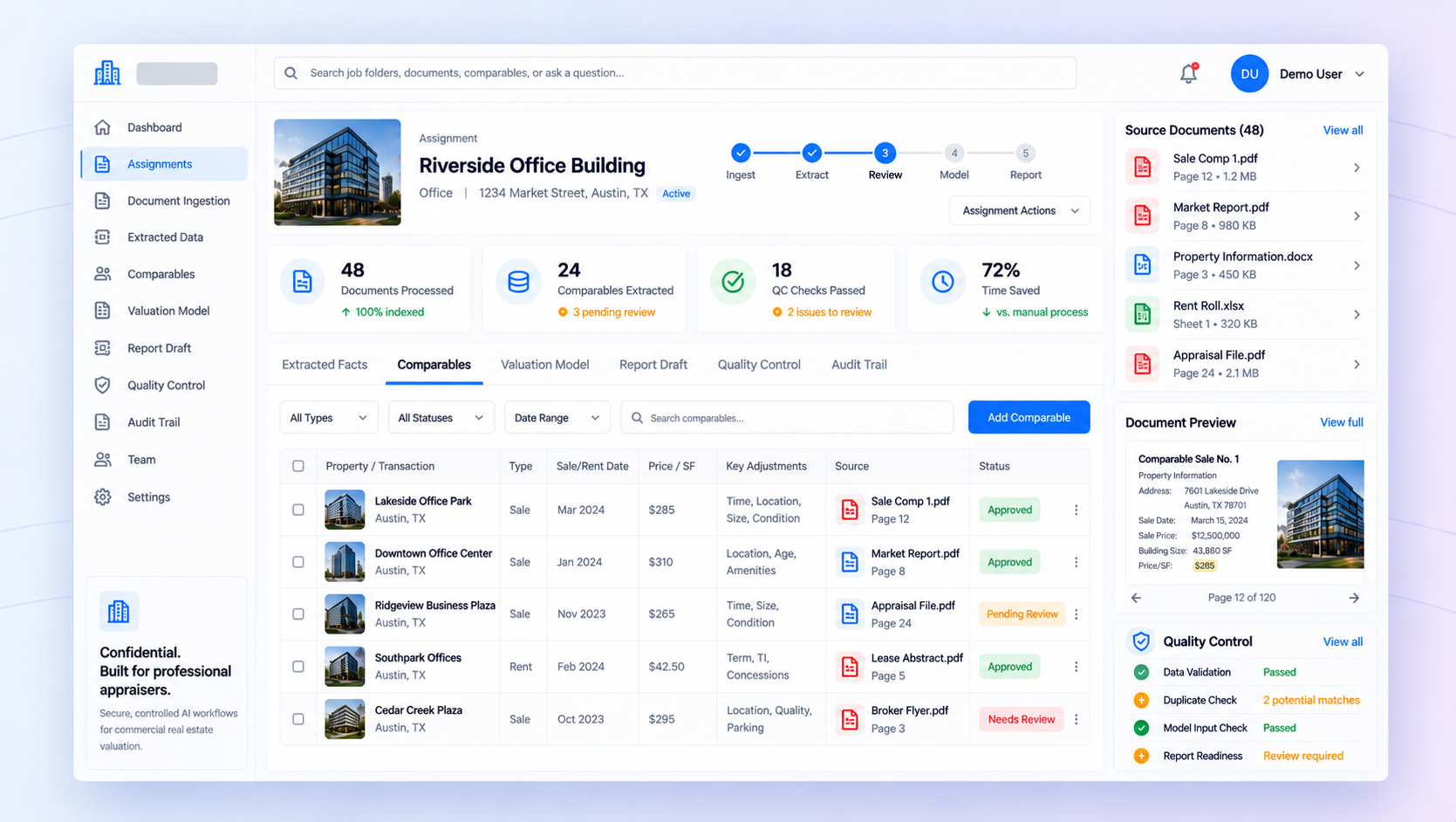
We delivered exactly that. A private, human-in-the-loop valuation intelligence platform that reads authorized job folders through Microsoft Graph, extracts comparable sales, rents, and expenses with page-level citations, stages them for human approval, populates the firm’s existing Excel model and Word report template through formula-safe automation, and runs multi-layer quality control throughout. AI handles extraction, drafting, and review. Appraisers retain every professional decision. Every fact is traceable to its source. Every action is logged.
The founding design rule of the engagement was simple and non-negotiable: AI never makes appraisal judgments. That principle shaped every architectural decision from discovery through delivery.
About Client
The firm is an established commercial real estate appraisal practice operating under the professional and regulatory standards that govern licensed appraisers. Their work is document-heavy by nature. Each assignment draws on a mix of PDFs, scanned PDFs, Word files, Excel workbooks, and images spread across job folders, and the same facts have to be extracted, verified, and re-entered into both a valuation model and a formal report.
At the center of their workflow sits a proprietary Excel valuation model containing formulas, macros, and formatting that represent the firm’s professional methodology, built and refined over time to reflect how their appraisers work. Alongside it is a Word report template that follows the firm’s established structure and formatting standards. Both are professional assets. Neither could be altered by any automation the firm introduced.
Their data environment is equally sensitive. Client documents contain confidential information. The system had to operate entirely within the firm’s own Microsoft environment, with strict access controls, no client data in personal accounts or vendor repositories, and full compliance with the NDA and data-handling terms established before any real data was used.
The firm needed automation that accelerated the work around their appraisers’ decisions without ever encroaching on the decisions themselves.
The Challenge
Document-Heavy Work. Evidence-Sensitive Outputs. No Room for Unverifiable AI.
Commercial real estate appraisal sits at the intersection of professional judgment and rigorous evidence. The two are inseparable. An appraiser’s conclusions are only as defensible as the facts supporting them, and those facts have to be traceable, consistent, and correctly attributed every time.
The manual workflows surrounding that evidence management were creating compounding problems that grew more costly as assignment volume increased.
Comparable sales, rents, and expenses were being manually transcribed from source documents into the valuation model and report. That transcription process was time-consuming and error-prone, and it produced no systematic link between the figure that appeared in the model and the page of the source document it came from. If a figure was questioned, tracing it back to its origin required going back through the source documents manually.
Duplicate and identity problems added another layer of friction. The same property or transaction could enter the firm’s comp records more than once across different assignments, and a property could be confused with a single transaction on that property. Without automated detection, those inconsistencies required manual review to catch.
The Excel valuation model presented a constraint that could not be negotiated. Any automation that altered the formulas, macros, or formatting of the model would have been professionally unacceptable. The model represented the firm’s methodology. It had to remain exactly as it was, with population happening through mapped inputs and recalculation performed by native desktop Excel rather than by any external computation layer.
Defensibility and auditability added the highest-stakes dimension. Reports are signed by licensed appraisers. Every figure needs an evidence trail. Every approval decision needs a clear record of who made it and when. A system that automated any part of that workflow without comprehensive logging would have created more risk than it eliminated.
The firm needed automation that removed the clerical burden around evidence extraction, model population, and first-draft report text, without taking any professional judgment out of the appraiser’s hands, without touching their existing tools, and with a complete, append-only audit trail behind everything it touched.
That combination of requirements ruled out every off-the-shelf option. It needed to be built.
The Solution
A Governed, Evidence-First Valuation Workflow. Built Around the Appraiser, Not Around the AI.
Aegasis Labs designed and delivered the valuation intelligence platform through a structured engagement beginning with a paid discovery phase and followed by a phase-gated, fixed-price build over an approximately 16-week programme. All code, prompts, schemas, and documentation were committed continuously to the client’s own GitHub organization throughout. The firm owned everything from day one.
The architecture was built on a single governing principle: AI is confined to extraction, factual drafting, and review. Deterministic code and human approval gate everything that reaches production data, the valuation model, or the report. The appraiser decides. The platform handles the work around those decisions.
Evidence-First Document Ingestion
Authorized OneDrive and SharePoint job folders are read through Microsoft Graph, covering the full range of document types the firm works with: PDFs, scanned PDFs, Word files, Excel workbooks, and images. Every extracted value carries a page-level citation back to its source document from the moment of extraction. Traceability is not added later as a feature. It is built into the ingestion architecture from the start.
Schema-Validated AI Extraction
Claude extracts assignment facts and sale, rent, and expense comparables into strictly typed Pydantic schemas. Output that fails schema validation is rejected and retried rather than passed downstream. The validation layer means that malformed, incomplete, or structurally incorrect extractions never reach the staging database. The AI’s role is extraction of facts from documents. The schema’s role is ensuring those facts meet the structural standards the downstream workflow requires before anything else happens.
Human-Approved Staging
Extracted comparable records land in a Supabase and PostgreSQL staging layer and never reach production without explicit human approval. Duplicate detection and property-versus-transaction matching run before the approval step, supported by PostGIS for spatial matching across the comp database. Appraisers review staged records, resolve any flagged issues, and approve what moves forward. Nothing bypasses that gate.
Formula-Safe Excel Population
Approved facts populate the firm’s existing Excel valuation model through mapped inputs. Recalculation is performed by native desktop Excel running on a Windows 365 Cloud PC runner, using the firm’s own calculation engine rather than any external computation. Workbook formulas, macros, and formatting are left entirely untouched. Integrity checks verify after each population cycle that nothing in the model’s structure has changed. The firm’s professional methodology, embedded in that model over years of practice, stays exactly as it was.
Word Report Population
The firm’s existing Word report template is populated through Open XML automation. Factual sections are drafted only from approved facts, never from AI inference beyond what the source documents support. The template’s formatting is preserved exactly. The appraisers’ writing and professional framing remain their own. The platform handles the population of verified facts into the correct locations in the document structure.
Multi-Layer Quality Control
Deterministic checks run across extracted and staged data to catch structural inconsistencies and data integrity issues. Claude-based specialist reviewers provide an additional layer of AI-assisted review across specific QC dimensions. All findings from both layers route into an AppSheet queue where the appraisal team reviews and resolves them before reports are finalized. The QC process is systematic rather than dependent on individual reviewer attention in any given assignment.
Append-Only Audit Trail
Every read, write, model call, and approval is logged to an append-only audit trail. The complete history behind every figure in every report is recorded and accessible. If a figure is questioned, the trail shows where it came from, when it was extracted, who approved it, and what QC checks it passed through. That auditability is not a compliance checkbox. It is the foundation on which the firm’s defensibility rests.
Durable Orchestration with LangGraph
Long-running jobs run on a LangGraph-based workflow engine with retries and checkpoints. Interrupted work resumes cleanly from its last checkpoint rather than restarting from the beginning or creating duplicate records. For a workflow involving multiple document types, multiple extraction steps, and multi-stage approval, that durability is an operational necessity.
Security by Design
Entra ID authentication governs access throughout. PostgreSQL row-level security enforces strict data separation. Least-privilege access controls limit what each service and user can read and write to what their role requires. The threat model produced during discovery shaped these controls from the architecture stage rather than retrofitting security after build. No client data touches personal accounts or vendor repositories at any point.
Technologies Used
-
Python 3.12+, .NET (Open XML)
-
FastAPI, MCP tool services, LangGraph, Pydantic
-
Claude commercial API (structured, schema-validated output)
- Supabase, PostgreSQL (PostGIS, pgvector, row-level security)
-
Microsoft Graph, OneDrive, SharePoint, Entra ID, Windows 365 Cloud PC
-
Desktop Excel and Word automation (.NET, Open XML)
- Workflow orchestration, human-in-the-loop approval, append-only audit logging
Engagement Structure
We didn’t start writing production code on day one. That’s not how engagements like this should work.
Discovery (approximately 2 weeks): An approximately two-week paid discovery phase in which Aegasis Labs inspected the firm’s actual Excel and Word templates and delivered the full architecture, threat model, data model, Excel and Word mapping plans, programme schedule, and fixed milestone pricing. The first milestone proved the complete chain end to end: one sale comparable moving from a PDF in OneDrive, through staging and approval, into the Excel model, with complete evidence and audit trail. That milestone established confidence in the full architecture before the remaining build scope proceeded.
Build (approximately 16 weeks, phase-gated). Fixed-price milestones over an approximately 16-week program, with code, prompts, schemas, and documentation committed continuously to the client’s GitHub organization throughout.
Support All code, prompts, schemas, and documentation committed continuously to the firm’s own GitHub organization. No vendor lock-in. The firm owns everything.
How We Worked Together
This engagement followed Aegasis Labs‘ four-step delivery approach, adapted to the governed, phase-gated structure the brief required:
- Discover. We began with a paid discovery phase to inspect the firm’s real templates, map their operational workflows, and produce the architecture, threat model, data model, and Excel and Word mapping plans before any build commitment was made. The discovery output became the build specification.
- Design. The human-in-the-loop architecture, schema validation layer, staging and approval workflow, formula-safe Excel population approach, and security model were all designed as a coherent system during discovery, so the build phase executed against a validated plan rather than an evolving one.
- Build. Our team delivered across the full stack through fixed-price milestones, with the first milestone proving the end-to-end chain before the full programme proceeded. Every deliverable was committed to the client’s own GitHub organization continuously.
- Scale. The modular, MCP tool service architecture means individual capabilities can be extended, tested, and audited independently. New document types, additional comp categories, and expanded QC rules can be added without re-engineering the core workflow.
The Results
Full Evidence Traceability. Appraiser Judgment Preserved. Complete Auditability Throughout.
The platform gave the firm a controlled, defensible way to bring automation into their valuation workflow without compromising the professional standards their practice depends on.
Full evidence traceability at the page level Every extracted fact, comparable, and report figure traces back to a specific page in a specific source document. The link between the number in the report and the document it came from is systematic and always available, not dependent on manual record-keeping.
Cleaner comparable data entering the workflow Duplicate detection and property-versus-transaction matching keep the comparable database clean before records are approved. Inconsistencies that previously required manual review to catch are surfaced automatically before they reach the appraiser’s attention.
Appraiser judgment preserved throughout Appraisers select the comparables, set the adjustments, reconcile the value, and sign the report. Clerical data entry, model population, and first-draft factual text are automated. The professional work remains entirely with the licensed appraiser. The platform removes the work around those decisions, not the decisions themselves.
Existing professional assets protected The firm’s valuation model and report template remain exactly as they were, with formulas, macros, and formatting intact. The firm’s methodology is not altered by the automation introduced around it.
Complete auditability for every figure The append-only audit trail records every read, write, model call, and approval across every assignment. The complete history behind every figure in every report is recorded, accessible, and defensible.
Consistent quality control before finalization Multi-layer QC surfaces issues in a single AppSheet queue before reports are finalized. The review process is systematic rather than dependent on individual attention, giving the firm consistent quality control across every assignment regardless of volume.
Full client ownership of all deliverables All code, prompts, schemas, and documentation live in the firm’s own GitHub organization. The firm owns everything the engagement produced, with no dependency on Aegasis Labs‘ repositories or infrastructure.