AI Technology Trends 2026: The Essential Guide for Leaders


Consulting

- 30 Aug, 2026
- 876 Views
- 0 Comment
Introduction
Technology doesn’t sleep. And for most businesses, neither do the problems that come with it — slow systems, security gaps, overwhelmed internal teams, and the constant pressure to keep everything running while simultaneously trying to grow.
That’s exactly why managed IT services have become one of the most strategically important decisions a modern business can make.
But “managed IT services” is a phrase that gets thrown around loosely. MSP, managed IT support, IT management services — the terminology can feel like a maze if you’re new to it. And even if you’re not new to it, the landscape has shifted dramatically in recent years. AI, cloud infrastructure, and automation have fundamentally changed what a capable managed IT partner looks like in 2024.
This guide cuts through the noise. Whether you’re exploring managed IT for the first time or re-evaluating your current provider, you’ll come away knowing exactly what managed IT services are, what they should include, how to evaluate providers, and what the future of intelligent IT management looks like.
Let’s get into it.
Table of Contents
- What Are Managed IT Services?
- How Managed IT Services Work
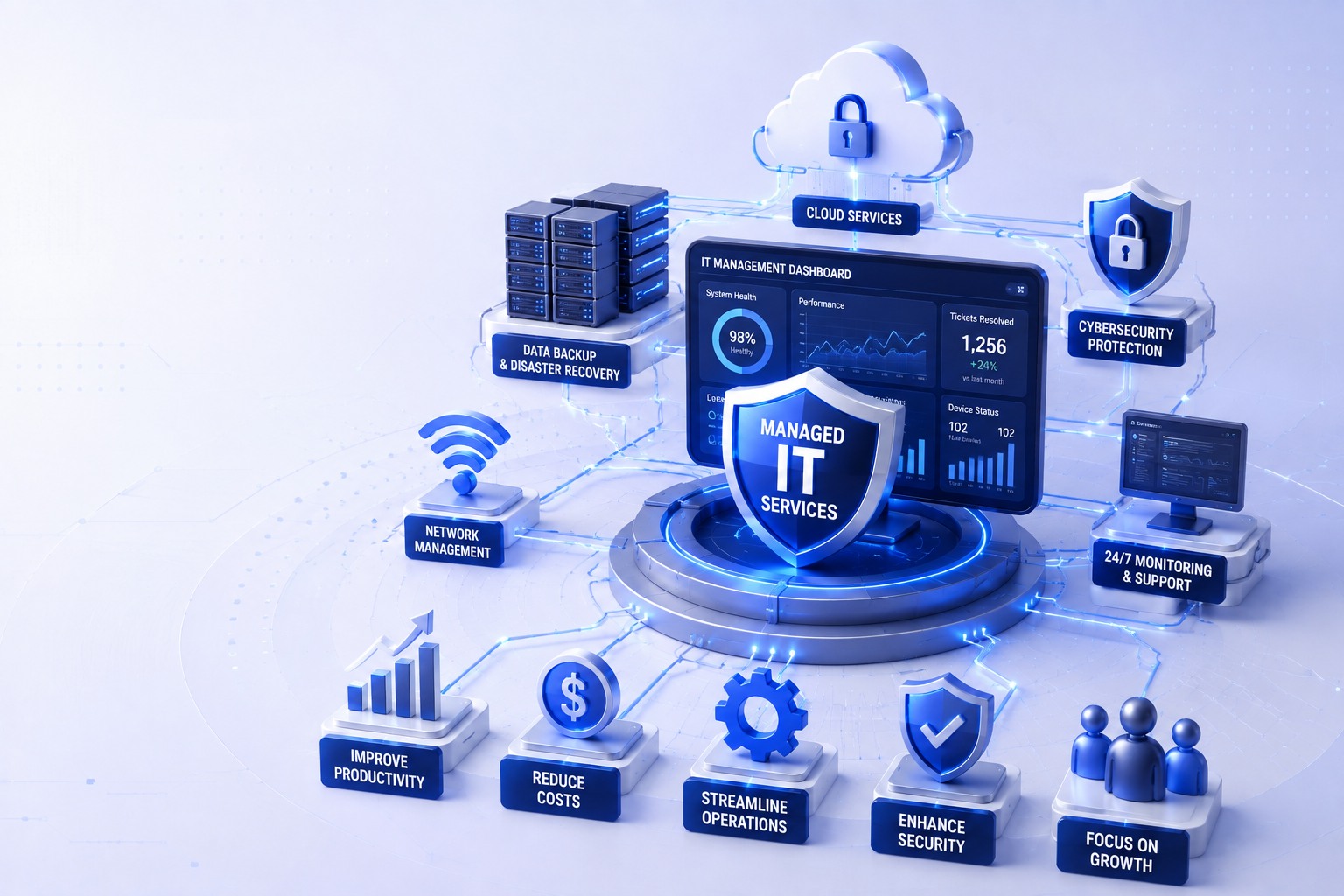
- Core Services a Managed IT Provider Should Offer
- The Business Case: Key Benefits of Managed IT Services
- Managed IT Security: Why It Deserves Its Own Conversation
- Managed IT Services vs. In-House IT: An Honest Comparison
- How to Choose the Right Managed IT Provider
- What to Expect from the Onboarding Process
- The Future of Managed IT: AI and Intelligent Automation
- Common Mistakes Businesses Make When Choosing an MSP
- Frequently Asked Questions
1. What Are Managed IT Services?
Managed IT services is a model where a business outsources the management, monitoring, and support of its IT infrastructure and operations to a third-party provider — known as a Managed Services Provider (MSP).
Rather than reacting to problems after they occur, a managed IT provider proactively monitors your systems, handles maintenance, manages security, and supports your technology needs on an ongoing basis. The relationship is typically governed by a Service Level Agreement (SLA), which defines response times, uptime guarantees, and scope of support.
Think of it this way: instead of calling a plumber every time a pipe bursts, you hire someone to maintain your entire plumbing system, catch issues before they become emergencies, and keep everything running efficiently year-round. That’s what a managed IT provider does for your technology.
The model has evolved considerably. Early MSPs were largely reactive help desks — fixing broken computers and resetting passwords. Today, leading managed IT providers deliver strategic guidance, cloud infrastructure management, cybersecurity, data engineering, AI implementation, and business intelligence. The difference between a capable MSP and a basic one has never been wider.
2. How Managed IT Services Work
The mechanics are straightforward, even if the technology underneath isn’t.
Remote Monitoring and Management (RMM) is the foundation. Your MSP deploys monitoring tools across your infrastructure — servers, endpoints, networks, cloud environments — that continuously track performance, flag anomalies, and alert engineers before issues escalate.
A ticketing and support system handles requests from your team. Users can submit issues through a portal, email, or phone. Tickets are triaged, assigned, and resolved according to the SLA.
Regular maintenance and patching keeps your systems current and secure. This happens largely in the background — scheduled updates, security patches, software management — without disrupting your operations.
Strategic reviews (typically quarterly) give leadership visibility into what’s happening across the technology landscape: what’s working, what’s at risk, and where investment should go next.
The commercial model is usually subscription-based — a predictable monthly fee tied to the number of users, devices, or service tiers. This is one of managed IT’s most underrated advantages: converting unpredictable IT costs into a stable, budgetable line item.
3. Core Services a Managed IT Provider Should Offer
Not all MSPs are built the same. Here’s what a full-service managed IT provider should bring to the table:
Network and Infrastructure Management
Monitoring and managing servers, routers, switches, firewalls, and all the hardware that keeps your operations running. This includes performance optimisation, capacity planning, and ensuring uptime across your environment.
Help Desk and End-User Support
Fast, responsive support for your team when things go wrong. Response times should be clearly defined in your SLA. The best providers offer multi-channel support — phone, email, portal, chat — with tiered escalation for complex issues.
Cloud Services and Management
Whether you’re on AWS, Microsoft Azure, Google Cloud, or a hybrid environment, your MSP should handle provisioning, cost optimisation, migration, and ongoing management. [LINK: Cloud & Data Engineering] Cloud is no longer optional — managing it well is a competitive differentiator.
Cybersecurity and Managed IT Security
Threat detection, endpoint protection, vulnerability assessments, patch management, compliance support, and incident response. This deserves its own section — and we’ll get to it shortly.
Backup and Disaster Recovery
Regular automated backups, tested recovery procedures, and documented business continuity plans. If a ransomware attack or hardware failure hits, you need confidence that recovery is measured in hours, not weeks.
Software and Licence Management
Tracking what software you’re running, ensuring licences are current, managing renewals, and identifying redundant tools that are costing you money without adding value.
Strategic IT Consulting
This is where the best MSPs separate themselves. Beyond keeping the lights on, a capable managed IT partner should help you make smart technology decisions — evaluating new tools, building technology roadmaps, and aligning IT investment with business goals. [LINK: AI & Data Strategy]
4. The Business Case: Key Benefits of Managed IT Services
The case for managed IT services is strong — and it extends well beyond “someone else handles the headaches.” Here are the benefits that matter most to operations leaders and CTOs.
Predictable Costs
Unplanned IT failures are expensive. Emergency contractor rates, hardware replacements, productivity losses from downtime — the costs stack up fast and unpredictably. Managed IT converts that exposure into a fixed monthly fee. You know what you’re spending. You can budget for it properly.
Access to Expertise You Can’t Afford to Hire
A single internal IT hire — even a capable generalist — can’t match the breadth of a managed services team. You get access to specialists across networking, security, cloud, compliance, and software development without the overhead of full-time salaries, benefits, and training costs.
Proactive Problem Prevention
The shift from reactive to proactive is perhaps the most valuable operational change managed IT delivers. Your MSP is watching your systems continuously. Many issues are identified and resolved before they become outages — and before your team even notices.
Scalability
Business growth creates technology complexity. New offices, remote teams, product launches, acquisitions — each adds load to your IT infrastructure. A managed IT provider scales with you, adding capacity and capability without the hiring lag of building an internal team.
Focus on Core Business
Your leadership team’s attention is finite. Every hour spent managing IT vendor relationships, chasing down system issues, or worrying about security is an hour not spent on strategy, customers, or growth. Managed IT services hand that cognitive load to specialists.
Stronger Security Posture
Cybersecurity is increasingly non-negotiable, and it’s increasingly complex. Managed IT providers maintain dedicated security practices, stay current on emerging threats, and apply enterprise-grade protection that most SMEs and mid-market businesses couldn’t replicate independently.
Compliance Support
Whether you’re navigating GDPR, ISO 27001, SOC 2, HIPAA, or industry-specific regulations, a knowledgeable MSP can help you understand your obligations and build compliant systems from the ground up.
5. Managed IT Security: Why It Deserves Its Own Conversation
Cybersecurity is no longer a niche IT concern. It’s a board-level risk. And for many businesses, it’s the single most compelling reason to engage a managed IT provider.
The threat landscape has changed. Attacks are more frequent, more sophisticated, and more targeted at mid-market businesses that have valuable data but less mature defences than large enterprises. Ransomware, phishing, supply chain attacks, insider threats — the vectors multiply every year.
A strong managed IT security offering should include:
Endpoint Detection and Response (EDR) — Advanced threat detection on every device, with automated response to isolate compromised endpoints before damage spreads.
Security Information and Event Management (SIEM) — Centralised logging and analysis of security events across your environment, identifying patterns that indicate compromise.
Vulnerability Management — Regular scanning and prioritised remediation of weaknesses in your infrastructure before attackers can exploit them.
Multi-Factor Authentication (MFA) and Identity Management — Securing access to systems and data at the identity layer, which is where the majority of breaches begin.
Security Awareness Training — Your people are the most common entry point for attackers. Regular training and phishing simulations reduce human error dramatically.
Incident Response Planning — Not if, but when. Having a clear, tested incident response plan means the difference between a contained security event and a business-disrupting crisis.
The best managed IT providers don’t treat security as an add-on. It’s embedded into every layer of their service delivery — from how they design your infrastructure to how they monitor it daily. [LINK: Enterprise AI Automation]
6. Managed IT Services vs. In-House IT: An Honest Comparison
This is the question most operations leaders wrestle with at some point. Let’s be direct about the trade-offs.
The Case for In-House IT
An internal team knows your business intimately. They’re on-site, embedded in your culture, available for face-to-face collaboration, and can develop deep familiarity with your specific systems over time. For very large enterprises with complex, bespoke infrastructure, a substantial internal team often makes sense — usually working alongside external partners rather than replacing them entirely.
The Case for Managed IT Services
Breadth of expertise. One internal hire is a generalist by necessity. A managed IT provider brings a bench of specialists — cloud architects, security engineers, data engineers, AI developers — available as needed without full-time overhead.
Cost efficiency. Fully loaded, a senior IT hire costs considerably more than a monthly MSP fee, without the specialist coverage. For most mid-market businesses, managed IT delivers more capability per pound spent.
24/7 coverage. Most internal teams work business hours. Managed IT providers monitor your systems around the clock, including nights, weekends, and holidays.
Objectivity. An external partner evaluates your technology landscape without internal politics or attachment to legacy decisions. Their recommendations are driven by what’s best for your outcomes.
Speed. Recruiting IT talent is slow and competitive. A managed IT provider can be operational within weeks, not months.
The Hybrid Model
Many organisations — especially scaling businesses and mid-market companies — run a hybrid model: a lean internal IT lead who manages vendor relationships and internal communication, working alongside a managed IT provider who handles the technical depth. It’s an increasingly popular structure, and often the most effective one.
7. How to Choose the Right Managed IT Provider
Choosing an MSP is one of the most consequential technology decisions your business will make. The wrong choice means slow support, misaligned strategy, and technology that holds you back. The right one becomes a genuine competitive advantage.
Here’s how to evaluate your options:
Define Your Requirements First
Before you speak to a single provider, get clear on what you actually need. What are your biggest pain points? What does your current infrastructure look like? What are your compliance obligations? Where are you planning to grow? The answers shape everything.
Evaluate Technical Breadth
Can they cover your full stack? A provider that specialises in network support but has limited cloud or security capability will create gaps. Ensure their expertise aligns with where your technology is heading, not just where it is today.
Check Certifications and Partnerships
Credible MSPs hold certifications from major technology vendors — AWS, Microsoft, and others. These aren’t just marketing badges; they indicate demonstrated technical competency and access to partner-level support and resources.
Scrutinise the SLA
Response time commitments, uptime guarantees, escalation procedures, and remedies for SLA breaches should all be clearly defined. A vague SLA is a red flag.
Ask About Security Practices
How do they secure their own operations? How do they handle your data? What happens if they experience a breach? Your MSP has significant access to your systems — their security posture matters as much as their technical skill.
Look for Strategic Capability
The best managed IT providers don’t just maintain your technology — they help you evolve it. Ask whether they offer strategic roadmapping, technology advisory, and input on major decisions. A partner who only reacts to problems isn’t helping you build competitive advantage. [LINK: AI & Data Strategy]
References and Track Record
Ask for client references in your industry. A provider that’s delivered results across multiple sectors and project types — with a strong completion rate — is a fundamentally different proposition from one with limited proven experience.
Cultural Fit
You’ll work closely with this team. Communication style, responsiveness, and cultural alignment matter. The technical skills matter more, but a technically excellent provider who communicates poorly will still frustrate your team.
8. What to Expect from the Onboarding Process
Onboarding sets the tone for the entire relationship. A well-run onboarding process covers:
Discovery and audit. Your provider should conduct a thorough review of your current infrastructure — hardware, software, network configuration, security posture, cloud environment, and any existing documentation. This surfaces immediate risks and establishes a baseline.
Documentation. Everything gets documented: network diagrams, device inventories, software licences, credentials (stored securely), and escalation contacts. Good documentation is the foundation of fast, accurate support.
Tool deployment. RMM agents, security tools, backup software, and monitoring systems get deployed across your environment. This typically happens in the background with minimal disruption.
SLA alignment and communication setup. How do your team members submit tickets? Who are the escalation contacts on both sides? What are the expected response times for different issue types? These details get agreed and communicated clearly.
Handover from previous provider (if applicable). If you’re transitioning from another MSP or from an internal team, a clean handover process — with data, documentation, and access transferred properly — is critical. Don’t underestimate this step.
A reputable provider makes onboarding feel structured, not stressful. If the onboarding process is chaotic, the ongoing relationship usually reflects that.
9. The Future of Managed IT: AI and Intelligent Automation
The managed IT services landscape is shifting — rapidly. And the shift is being driven by artificial intelligence.
Traditional MSPs have operated on a fundamentally reactive model, even when they describe themselves as proactive. Human engineers monitor alerts, investigate incidents, and resolve tickets. That model has limits: humans get tired, miss patterns in large datasets, and can only process so many alerts simultaneously.
AI changes the calculus entirely.
Predictive maintenance uses machine learning to analyse system behaviour patterns and predict failures before they occur — often days in advance of any human-visible symptom.
Intelligent threat detection processes security event data at a scale and speed no human team can match, identifying anomalies and correlating signals across your entire environment in real time.
Automated remediation handles routine issues — service restarts, patch deployments, access provisioning — without human intervention, reducing resolution times from hours to minutes.
AI-powered analytics turn the data generated by your IT environment into genuine business intelligence: utilisation trends, cost optimisation opportunities, performance bottlenecks, and capacity forecasts. [LINK: Analytics & Business Intelligence]
Generative AI integration is beginning to transform how teams interact with their IT environment — from natural language querying of system status to AI-assisted documentation and intelligent service desk chatbots that resolve tier-1 issues instantly. [LINK: Generative AI Applications]
This isn’t future-state speculation. The most capable managed IT providers are deploying these capabilities today. The gap between AI-augmented IT management and traditional MSP delivery is growing — and it’s growing fast.
For businesses, this means the question isn’t just “should we use a managed IT provider?” It’s “are we working with a provider that’s building for where technology is going, not just where it’s been?”
10. Common Mistakes Businesses Make When Choosing an MSP
After seeing how these partnerships play out across dozens of engagements, certain patterns emerge. Here are the mistakes that cost businesses the most.
Choosing on price alone. The cheapest MSP is almost never the most cost-effective one. When an underfunded provider can’t respond quickly, misses a security event, or delivers advice that sets you back strategically, the true cost far exceeds what you saved on the monthly fee.
Not defining requirements before talking to providers. Walking into vendor conversations without a clear picture of your needs means you end up being sold to, not advised. Know your pain points before the sales conversation starts.
Ignoring cultural fit. A technically strong provider who communicates poorly, responds defensively to feedback, or treats your team dismissively will create friction at every turn. Technical capability and cultural fit both matter.
Underestimating the security requirement. Many businesses treat security as an upgrade tier rather than a baseline. In today’s threat environment, endpoint protection, identity management, and threat detection aren’t optional extras.
Not reviewing the SLA carefully. “24/7 support” can mean many things. What’s the actual response time for a critical incident? What constitutes a critical incident? What are the remedies if the SLA is breached? Read the detail.
Treating it as a vendor relationship rather than a partnership. The MSPs that deliver the most value are the ones engaged as genuine technology partners — invited into strategic conversations, given context about where the business is going, and trusted to give honest counsel. Keep them at arm’s length and you’ll get transactional service.
Failing to plan for transition. Switching MSPs mid-flight is disruptive. Plan transitions carefully, ensure clean documentation handover, and allow enough overlap time to stabilise before the previous provider disengages.
11. Frequently Asked Questions
What is the difference between managed IT services and break-fix IT support?
Break-fix IT support is reactive: something breaks, you call someone, they fix it, you pay for the time. Managed IT services is a proactive, ongoing model — continuous monitoring, regular maintenance, and strategic support for a predictable monthly fee. The managed model prevents many of the issues that break-fix only addresses after the damage is done.
How much do managed IT services cost?
Pricing varies based on the scope of services, number of users and devices, complexity of your infrastructure, and provider. Most managed IT providers use a per-user or per-device monthly pricing model. The right question isn’t “how much does it cost?” but “what does it cost compared to the alternative?” — including the hidden costs of downtime, security incidents, and underperforming systems.
Can managed IT services work alongside an internal IT team?
Absolutely. The hybrid model is increasingly common and often the most effective structure for mid-market and enterprise businesses. Internal IT leads focus on business alignment and vendor management; the managed IT provider delivers technical depth and 24/7 coverage.
How long does it take to onboard with a new managed IT provider?
Typically two to six weeks for a standard onboarding, depending on the complexity of your environment. A thorough provider won’t rush this process — the discovery and documentation phase sets the foundation for everything that follows.
What industries benefit most from managed IT services?
Managed IT services deliver value across virtually every industry, but the impact is particularly significant in sectors with complex compliance requirements, sensitive data, or high operational continuity demands — healthcare, financial services, manufacturing, retail, and professional services among them.
What should be in a managed IT services SLA?
At minimum: response time commitments by issue severity, uptime guarantees, escalation procedures, scope of covered services, security responsibilities, data handling practices, and remedies for SLA breaches. Read it carefully before signing.
How is AI changing managed IT services?
AI is enabling managed IT providers to shift from reactive to genuinely predictive operations. Machine learning models identify infrastructure anomalies before they become failures. Automated remediation handles routine issues without human intervention. Intelligent security tools detect and respond to threats at machine speed. The most forward-thinking MSPs are building AI deeply into their service delivery — not as a marketing claim, but as an operational reality. [LINK: Enterprise AI Automation]
Conclusion
Managed IT services has evolved from a cost-saving tactic into a strategic capability. The businesses that get the most from it aren’t just offloading IT headaches — they’re gaining access to expertise, infrastructure, and intelligence that accelerates how they operate and grow.
The right managed IT provider doesn’t just keep your systems running. They help you understand your technology landscape clearly, make smarter decisions, move faster than you could alone, and build the kind of resilient, scalable foundation that growth actually requires.
And as AI continues to reshape what intelligent IT management looks like, the gap between forward-thinking providers and traditional MSPs will only widen.
Choosing well matters. Choose a partner who’s building for where technology is going — not just where it’s been.
At Aegasis Labs, we work with mid-market and enterprise businesses to deliver AI-first technology solutions that create measurable impact. With a 97% project completion success rate, 95% client satisfaction, 70+ projects delivered across 8+ industries, and certified partnerships with AWS and Microsoft, our team of 30+ expert consultants brings the depth and breadth your technology strategy demands.